Welcome!

Welcome! There are more than 900 Inspirational Quotes For Writers, Artists and Other Creative Leaders on this site.
Spend a few minutes exploring. And come back again and again for other inspirational quotes.

Saturday, March 5, 2011

Ernest Hemingway


"The best people possess a feeling for beauty, the courage to take risks, the discipline to tell the truth, the capacity to sacrifice.  Ironically, their virtues make them vulnerable; they are often wounded, sometimes destroyed."


American Novelist
1899 - 1961


As writers, artists and creative leaders we often are vulnerable to the hostile, negative behavior of people who do not understand us and what we represent.  These negative people can be our friends and family initially and the wider world eventually as our creative ideas and works try to find their place in that world.  We need to remain strong and courageous in the face of negative attacks.

As creative leaders we often sacrifice much to achieve our dreams.  We become so focused on and obsessed with our work that we ignore family and friends.  We miss out on the joys of life.  We may forget to take care of our health.  We drink and/or take drugs to kill the demons chasing us.  We suffer ridicule at the hands of those who don't understand us and what we do.

People may hate us when we tell the truth.  Often people are not ready for the truth we have to speak.  They may criticize and condemn us.  They may laugh at us.  We must find the discipline and the courage to speak the truth anyway — to open up and share our thoughts and feelings, to share the beauty we see.

Hemingway At Work


Friday, March 4, 2011

Stanley Kunitz

"The poem in the head is always perfect.  Resistance begins when you try to convert it into language."


American Poet
1905 - 2006


This statement by Stanley Kunitz sums up one of the key challenges that every creative leader faces.  What we create in the physical world never is as good as what we imagine in our minds.  Most artists, writers and performers are never satisfied with the end product because we see something different in our mind's eye.  And we have to learn to accept that it is okay to be imperfect.  Perfection is unachievable.  In fact, as humans what makes us interesting is our flaws.  And the same thing is true of our art.  It is the mistakes that make our art unique.  If the work we created was perfect, then every piece of art would look the same.  It is our flaws and weaknesses that make our art uniquely ours.  Our imperfections help make the art perfect.

Here is a poem by Stanley Kunitz.

Passing Through

By Stanley Kunitz

     -- on my seventy-ninth birthday

Nobody in the widow's household
ever celebrated anniversaries.
In the secrecy of my room
I would not admit I cared
that my friends were given parties.
Before I left town for school
my birthday went up in smoke
in a fire at City Hall that gutted
the Department of Vital Statistics.
If it weren't for a census report
of a five-year-old White Male
sharing my mother's address
at the Green Street tenement in Worcester
I'd have no documentary proof
that I exist.  You are the first,
my dear, to bully me
into these festive occasions.

Sometimes, you say, I wear
an abstracted look that drives you
up the wall, as though it signified
distress or disaffection.
Don't take it so to heart.
Maybe I enjoy not-being as much
as being who I am.  Maybe
it's time for me to practice
growing old.  The way I look
at it, I'm passing through a phase:
gradually I'm changing to a word.
Whatever you choose to claim
of me is always yours;
nothing is truly mine
except my name.  I only
borrowed this dust.

Thursday, March 3, 2011

Marcel Proust

"The real voyage of discovery consists not in seeking new landscapes but in having new eyes."


French Novelist
1871 - 1922


For some people the environment is crucial to their happiness.  They let where they live affect their emotional life.  And there is some truth to the fact.  Cloudy days can bring people down.  Long winters give some people cabin fever.  Others need the mountains or the ocean or the prairie.  How does your environment affect you as an artist?  Does it inspire your creativity?  Does it make you hopeful?  Does it make you happy?

For other people like Proust and myself, the environment is less important?  I can create anywhere.  I can sit in a shopping mall and write poetry.  I can sit in a church and write.  As I write these words I am sitting in a hotel in South Carolina.  And the environment rarely affects my mood or happiness.  I love the mountains, the ocean and the prairie, but I don't need them to be happy.  I live inside my head.  Can you create anywhere?  Or must you be in a certain place?  A certain mood?  A special environment?


Wednesday, March 2, 2011

Sydney Smith

"Obstacles are those frightful things you see when you take your eyes off your goals."


English Writer, Anglican Clergy
1771 -1845


The reason many creative leaders don't reach their goals is that they are focused on the wrong thing.  People focus on all the reasons their feel they can't achieve their goals.  They need to focus instead on their goals. 

If you are focused on your goals, you will see over the obstacles, under the obstacles, around the obstacles and through the obstacles.  If you are focused on the obstacles, you will only see the obstacles and you will not achieve your goals.

What are your goals?  What are you focused on?  The obstacles?  Or the GOALS?  Banish the obstacles from your mind.  Focus on your goals.  Achieve your dreams.

Tuesday, March 1, 2011

Frank Stella


"One learns about painting by looking at and imitating other painters.  I can't stress enough how important it is, if you are interested at all in painting, to look and to look a great deal at painting.  There is no other way to find out about painting."


1936 - 
American Painter


I think one of the best ways of learning how to create is to study other artists, novelists, poets, musicians, dancers and storytellers.  And most creative leaders do.  The only exception is wanna-be poets.  I am always surprised when I meet a person who tells me that he writes poetry but he never reads it.  And I have probably met hundreds in my life.  If you want to perfect your art, you need to study other artists.  But don't limit yourself to your chosen medium.  Explore other arts.  If you are a painter, read poetry.  If you are a novelist, study landscape artists and portrait artists.  If you are a dancer, study the painters who painted dancers.  The message is simple:  creative leaders need to be studying other creative leaders for insight and understanding.


Harran II
(1967)

Monday, February 28, 2011

Vincent Van Gogh

Self-Portrait
(1887)
"I have a more or less irresistible passion for books and the constant need to improve my mind, to study if you like, just as I have a need to eat bread."


Dutch Painter
1853 - 1890


Do you have a passion for learning?  Have you read a book in the last month?  Or are you, as some people tell me, too busy to find time to read?  If you read one book a month you are in the top one percent of the population.  Van Gogh was a lifelong learner.  If you are interested in seeing some of the 29 books I have read in 2010, check out my list on Goodreads.com.   

http://www.goodreads.com/review/list/2103162-harley?shelf=read-2010

Learning does not just come from books.  You can learn a lot listening to the people you come in contact with.  In the last couple of airplane flights I have had the privilege to engage in conversation with two interesting people.  One was a minister who has spent 15 years in Japan.  We shared a love of Japanese culture.  The other was a recent college graduate who found a job within a month of graduating which given the state of the economy was an amazing feat.  People from other walks of life can teach you a lot.  Do you limit yourself to communicating only with people you know?  Or do you seek out interesting people and learn from them?

Don't limit yourself to just learning about your field of interest.  Explore new topics.  If you are an artist, you should know everything you can about art, but you should also explore other areas of interest.  Take seminars and workshops.  Listen to audio books.

Here is one of my favorite Van Gogh paintings.  

Potato Eaters
(1885)

In one of his letters, Van Gogh described this painting:  "I have tried to make it clear how those people, eating their potatoes under the lamplight, have dug the earth with those very hands they put in their dish, and so it speaks of manual labor, and how they have honestly earned their food."

Sunday, February 27, 2011

Harold S. Kushner

"If we put our soul into our work, if, rather than just going through the motions, what we do flows from the deepest part of our being, then after a burst of creativity, we need to replenish our souls."


American Rabbi, Author
1935 -


Sometimes we need to rest — to replenish our spirit.  We cannot work all the time.  How do you replenish your spirit — restore your energy?  Exercise?  Walking?  Reading?  Visiting friends?  Loafing?  Good farmers know the importance of leaving a field fallow so as to restore the nutrients in the soil.  How do you restore the nutrients in your soul?  Do you take the time to be with yourself without the noise and chaos of the world in which you live?  Do you spend time with your soul in meditation and prayer?  Have you learned how to relax — to slow the pace of your life?  Take time today to pause for a few minutes and listen to the spirit within your flesh.  Find comfort in the small acts like the dance of a child, the breeze in the trees, the scampering of a squirrel or the hug of a friend?  Gently love the world in which you find yourself.


Harold S. Kushner wrote a book, The Lord Is My Shepherd: Healing Wisdom of the Twenty-Third Psalm, in which he meditates on the meaning of the twenty-third psalm.  The words I quoted above come from the chapter entitled: He Restoreth My Soul.  Kushner tells the story of a group of people who were on safari in Africa and hired porters to carry their supplies.  After three days the porters insisted on stopping for a day to rest.  The porters claimed that they were stopping not because they were tired, but because they had walked too far too fast and they needed time for their souls to catch up.  Have you traveled too fast and left your soul too far behind?  Do you need to wait for your soul to catch up?

As a speaker, I travel a lot — both by car and by plane.  I am currently in the midst of five weeks of travel.  Every time I return home, it takes me a day or two to renew my spirit and allow my soul to catch up.  And sometimes I feel like my soul does not catch up with my body before I am back on the road chasing the tiger.  In my case, my writing of poetry helps my soul to find its way back to the body and restore my sense of who I am.  


The Twenty-Third Psalm


The Lord is my shepherd; I shall not want.
He makes me lie down in green pastures,
He leads me beside the still waters.
He restores my soul.
He guides me in straight paths for His Name's sake.
Yea, though I walk through the valley of the shadow of death,
I will fear no evil
For Thou are with me.
Thy rod and Thy Staff, they comfort me.
Thou preparest a table before me in the presence of mine enemies.
Thou anointest my head with oil,
My cup runneth over.
Surely goodness and mercy shall follow me all the days of my life,
And I will dwell in the House of the Lord forever.

Saturday, February 26, 2011

Gloria Steinem

"Without leaps of imagination or dreaming, we lose the excitement of possibilities.  Dreaming, after all, is a form of planning."


American Journalist, Author
1934 - 


Most of us underestimate the power and importance of dreaming — whether we are talking about day dreaming or sleep dreaming.  Sleep dreaming is one of my favorite times, especially in the twilight world between being awake or being asleep.  Dreams can feel so real and meaningful.  Years ago I kept a dream journal where I would record my dreams.  I have documented proof that I dreamed of marrying my wife a month before I met her.  So I do believe that dreams can predict the future.  I have experienced the excitement of possibilities.  Dreams are small windows into our souls.  

Day dreaming is a way to explore your options and find the right path.  Day dreaming helps creative leaders make decisions and take action.  As Steinem says, day dreaming is a form of planning, a way of preparing for what is to come.  Our minds are very powerful and we can see things our mind's eye before they happen.

Have you ever gone to sleep thinking of some problem and wake up with the answer?  You need to learn to harness the power of your dreams to help you creatively solve problems.  You need to increase your involvement with dreams.  My wife at a very young age discovered that she had the ability to consciously change her dreams.  If she did not like where her dreams were going she would change them while dreaming.  Today we call it lucid dreaming


Friday, February 25, 2011

Havelock Ellis

"Dancing is the loftiest, the most moving, the most beautiful of the arts, because it is no mere translation or abstraction from life; it is life itself."


British Physician, Writer, Psychologist
1859 - 1939


Dancing has never been my strong suit.  I grew up in a church where dancing was considered a sin.  I sinned in the seventh grade when I danced at a sock hop, but I have never felt comfortable dancing.  I have no rhythm. 

 I have learned that dancing is an art that touches the soul.  While I may never have rhythm, I can appreciate it in others.  I took a movement class 5 years ago that used movement to explore your purpose in life.  We created our life story through movement.  Some day I would like to participate in a workshop that combines dance, painting, storytelling and writing.  Who knows maybe I will create it myself. 

Thursday, February 24, 2011

Martin Luther

"Music is the art of the prophets, the only art that can calm the agitations of the soul; it is one of the most magnificent and delightful presents God has given us."


German Priest, Theologian, Bible Translator, Hymn Composer
1483 - 1546


For those who have not heard of Martin Luther, he was a Catholic priest who inspired the Prostestant Reformation in 1517 by nailing his 95 theses on the door of the church in Wittenberg, Germany.  He helped change the course of Christianity.  I heard about Martin Luther early in my life, but I never knew that he translated the Bible from Latin to German or that he composed hymns.  He had a creative nature.

And I believe as does Martin Luther that music heals the soul and takes us to a whole other world.  Do you listen to music when your write or paint?  What kind of music inspires your creativity?  And if you compose music, are you ever inspired by a painting or a novel?  I believe the arts are intertwined and interconnected and touch our souls at a deep level.


Wednesday, February 23, 2011

Irving Stone

"Art is a staple, like bread or wine or a warm coat in winter.  Man's spirit grows hungry for art in the same way his stomach growls for food."


American Novelist
1903 - 1989


Lust for Life
A novel about the life
of Vincent Van Gogh
Many people treat the creative spirit as a luxury, something that is not needed to live life.  And they are quite wrong.  Creativity is a crucial part of living.  If I did not have an outlet for my creativity, I would either go crazy or die.  Creativity is at the very core of who I am.  If I go too long without writing, without putting words on paper, I begin to feel a hunger growing inside me.  I have a strong need to create, to produce something either through writing or painting.  It is as important to my life as water, air, food, shelter and companionship.  Without it my spirit would shrivel and die.  We need food for the body and food for the spirit.  Creativity provides the food for the spirit.


Here are scenes from the movie, Lust for Life, based on the novel by Irving Stone.


Tuesday, February 22, 2011

Jean-Auguste-Dominique Ingres

Self-Portrait
(1804)
"A painter can turn pennies into gold, for all subjects are capable of being transformed into poems."


French Artist
1780 - 1867


The Valpincon Bather
(1806)
Some people believe that art is only about painting beauty.  Other people believe that writers should not write about certain subjects.   And still others seek to censor artists and writers.  Think about books that have been banned in school districts or art that is considered pornographic.  The American Library Association publishes online a list of 100 novels that have been banned from time to time.

What subjects do you avoid painting or writing about?  In what ways do you censor your own creative tendencies.  Do you paint to please others?  Do you avoid writing about certain events because it could hurt others?  How do you choose the subjects that you paint or write about?  Or does the subject choose you?  Do write about what interests you or do you write what you think the world wants to read?  Consider how many writers now write about vampires since the success of Ann Rice.  Or how many writers follow in the footsteps of the Harry Potter books.

Do you think Ingres is correct?  Can a painter can turn pennies into gold?  Can a writer make any subject poetic?  

Louise de Broglie
(1845)

Monday, February 21, 2011

Jackson Pollack

"The painting has a life of its own.  I try to let it come through."


American Artist
1912 - 1956


Many painters and writers talk about the work of art as having a life of its own.  For me, this is one of the joys of the creative process — that moment of discovery when I am following the story, waiting to see where it will take me.  If the creative leader gets in the way of creative process, the work of art can be disfigured, paralyzed or even still born.  Don't let your idea of the painting or the story prevent the true work of art from being born.  What is in your mind's eye may not happen on paper or canvas.


Here is the trailer of a must see Jackson Pollock movie directed by Ed Harris.


Sunday, February 20, 2011

Lewis Mumford

"Humor is our way of defending ourselves from life's absurdities by thinking absurdly about them."


American Literary Critic, Historian, Philosopher
1895 - 1990


Life is full of absurd, strange and inconceivable happenings that could drive us insane if we did not have a sense of humor.  My wife told me a story today about an experience she had last weekend at a Barnes & Noble store we visit regularly.  She had made three separate purchases and written three separate checks when she discovered a fourth item she wanted to buy.  When she presented her fourth check in less than 2 hours, the computer system rejected it.  When the manager was called, she acted like my wife had written a bad check and treated her rudely.  My wife's response was to laugh at the absurdity of the situation and the stupidity of the manager before politely telling the manager that she would take her money and shop elsewhere.  Sometimes all we can do is laugh, because if we didn't we would go mad.  There was absolutely no excuse for the rude behavior of the manager.

I have worked in health care for over thirty-five years and have talked with lots of nurses about how they use humor to help them cope with the pain and death they saw daily.  They call it gallows humor.  Humor is one of the best ways of coping with the absurdities in our lives.


Winner of
The National Book Award
for Non-fiction (1962)
This past week I was giving a speech and a woman came up to me after the speech and told me how I had done a great job.  Her parting words were to tell me that I needed to take care of my health.  As I watched her walk away all I could do was laugh.  I know she meant well, but the statement came out of the blue and she knew nothing about my health.

Laughter is a powerful way of coping with the challenges we face.  Have you ever been rejected by a publisher or an art gallery?  Then take a deep breath and laugh at the absurdity of the situation.  Have critics ever given your creative work a bad review?  Then take a moment and laugh.  Are you unhappy with your work?  Instead of beating yourself up with negative self-talk, take a deep breath and laugh.  Find the absurdity in the pain you feel.

Saturday, February 19, 2011

Francis Bacon

Self-Portrait
(1971)
"The job of the artist is always to deepen the mystery."


English Artist
1909 - 1992


The Study After
Velazquez's Portrait
of Pope Innocent X
(1953)
Life is mysterious and full of questions with few answers.  The job of the creative leader is not to provide the answers but to help his audience to explore the questions at even deeper levels. Life at its core is spiritual in nature.  The artist connects the spiritual with the mysterious and fills the heart with joy.  Our challenge has writers, artists and creative leaders is to reach deep within our spirits and share the magical mystery of the heart.  


What spiritual questions are you exploring in your art?  Your writing?  Your acting?  Your dancing?  What is the mysterious hidden within your creation?  What is the song sung from your heart?

Friday, February 18, 2011

Theodore Roethke

"Being, not doing, is my first joy."


— Theodore Roethke
American Poet
1908 - 1963


I must confess that being is very difficult for me.  For years I have been caught up in the culture of doing.  Setting goals and working to achieve my goals.  I find it very difficult to sit and just be.  I must at the very least doodle and who knows maybe my doodles will one day be famous.  We can dream can't we!  If I go on vacation, it often takes me a week to relax and forget my day job.  But I still feel I must be doing something.  Writing.  Drawing.  Producing something.  Rarely can I just be.

How about you?  Are you caught up in the culture of doing or have you learned like Roethke to enjoy just being?

Here is my favorite Theodore Roethke poem.  I love the first three lines.  This is a poem to be read outloud.  Listen to the interaction of sounds.


The Waking


I wake to sleep, and take my waking slow.
I feel my fate in what I cannot fear.
I learn by going where I have to go.

We think by feeling. What is there to know?
I hear my being dance from ear to ear.
I wake to sleep, and take my waking slow.

Of those so close beside me, which are you?
God bless the Ground! I shall walk softly there,
And learn by going where I have to go.

Light takes the Tree; but who can tell us how?
The lowly worm climbs up a winding stair;
I wake to sleep, and take my waking slow.

Great Nature has another thing to do
To you and me, so take the lively air,
And, lovely, learn by going where to go.

This shaking keeps me steady. I should know.
What falls away is always. And is near.
I wake to sleep, and take my waking slow.
I learn by going where I have to go.

Thursday, February 17, 2011

William Makepeace Thackeray

"The world is a looking glass and gives back to every man the reflection of his own face."


— William Makepeace Thackeray
English Novelist
1811 - 1863


This is a very profound statement.  The world that we see is a reflection of ourselves.  I tell a story in my seminars about a little girl who lives in the mountains with her parents.  One day the little girl has a fight with her mother and she runs out of the house.  When she reaches the edge of the cliff, she stops and yells at the top of her voice: "I hate you.  I hate you."  To her surprise she hears a voice shouting back at her:  "I hate you.  I hate you."  This frightens the little girl and she runs back into the house and tells her mother that someone out there hates her.  Her mother realizing what happened tells her young daughter to go back outside and shout, "I love you."  The little girl tiptoes back outside and nervously tiptoes to the edge of the cliff.  She calls out: "I love you.  I love you."  Echoing back out of the valley, she hears the words, "I love you.  I love you."  The message is quite clear:  what we send out is what we get back.

What we expect to find in the world is what we find.  If we think the world is a negative hostile place where our competition is seeking to destroy us, we will find examples to prove our world view.  If we think the world is helpful and supportive, we will find examples to prove our vision of the world.  The world we see is a reflection of the person we are.  Have you looked in the mirror lately?  What kind of person do you see?

Wednesday, February 16, 2011

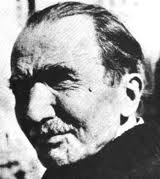
Nikos Kazantzakis

"I fear nothing, I hope for nothing, I am free."


Greek Novelist
1883 - 1957


Years ago I read the fascinating novel, The Last Temptation of Christ, by Nikos Kazantzakis.   The novel is an attempt to put a human face on Jesus Christ and take him out of the spiritual world where he is God.  The book has since been made into a movie.  I don't recall if this quote is from the book, but it could be given the storyline.

What kind of person would make this kind of statement?  Who among us is not afraid of something?   Who hopes for nothing?  And does freedom really mean having no fear and no hope?  Should the creative leader fear nothing?  Should the artist hope for nothing?  Can a novelist ever be free?  And what is freedom, anyway?  Every society places constraints on its citizens.  Society by its very nature has rules and regulations to govern interaction between people.  Artists often attempt to step outside the boundaries laid down by society.  Some are successful and others are destroyed in the process.

Is Nikos saying that if we have hopes and fears that we are not free?  How can a creative leader function if he does not have hope?  Wouldn't he stop living?  While many of us wish that we did not have fears, there is a positive aspect of fear.  It can protect us from real danger.  Would you want to live without fear?