Welcome!

Welcome! There are more than 900 Inspirational Quotes For Writers, Artists and Other Creative Leaders on this site.
Spend a few minutes exploring. And come back again and again for other inspirational quotes.
Showing posts with label Five Senses. Show all posts

Monday, April 18, 2016

Robert Henri — Visual Memory


Philosophers have long said that we experience the world through our senses, and scientists have confirmed this.  The ability to see is one of our dominant senses.  The question that Robert Henri is raising here is about our memory of what we see.  Both painters and writers need strong visual memory in order to put detail into their work.  Painters often work from observing models, but they also need to be able to work from the memory of that model.  The same is true of writers.  We must be able to describe our characters, the setting and the physical world.  Often the physical world provides the reader with insight into the nature of a character.
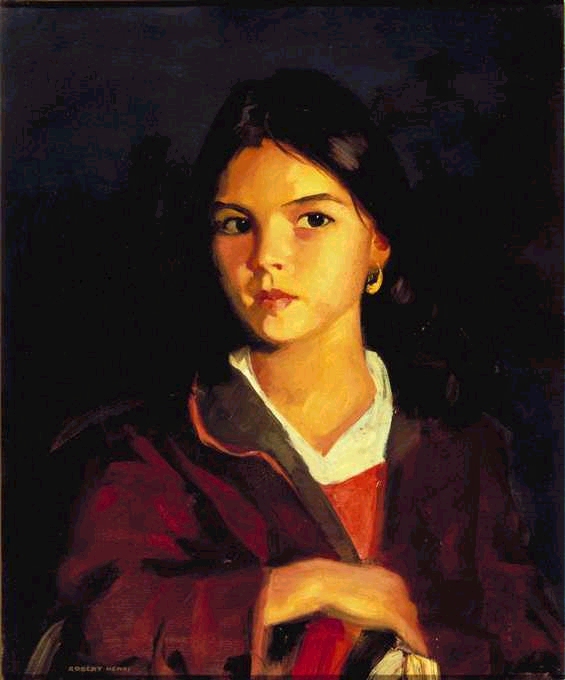
Bernadita (1926)
Robert Henri
Visual memory is something I struggle with both as a writer and a reader.  When I come to a long descriptive passage in a novel, I will skim through it quickly so as not to be bored.  When I write, I struggle to put in visual detail of the person and his surroundings.  As a speaker I can be in a room for eight hours with a group of people, but at the end of the day I could not describe their faces or the clothes they were wearing.  

The only place where I have discovered that I have a strong visual memory is when I am driving.  I can have driven through a city once and come back five years later and I will remember visual elements and be able to find my way around without getting lost. Somehow subconsciously, my brain picks up the physical clues and I remember them when I am back in the same place, but if you were to ask me to describe the place I could not.

For the past fifteen years I have been cultivating my visual memory through the study of art. If your visual memory is weak like mine, I would encourage you to find ways to improve your visual literacy.  Most creative leaders need a strong visual memory.

Monday, October 20, 2014

Richard Wollheim


"Learning appears as a way of staying young, perhaps of staying alive, and also as a way of growing up, perhaps facing death."


British Author, Philosopher
1923 - 2003


Commentary
Life-long learning is a powerful habit to develop. Learning something new keeps us in touch with our youth and helps us to stay active and alive. What have you learned in the last week? The past month?  Who has taught you something new about yourself or your art?

We experience the world through our senses — hearing, seeing, tasting, touching and smelling. And what we experience teaches us much if we are paying attention and alert to the possibilities. Did you smell the wind today? Did you hear the approaching storm? Do you taste the rain on your face?

From the time we are born until we die, our purpose is to learn, to grow, and to change. Most learning does not occur in school and we don't stop learning once we graduate. Cultivate a learning attitude. Unfortunately, many people do not learn from their mistakes. They are not willing to change and grow. To be a great artist or writer, you must be constantly learning about the world in which we inhabit.

And when we face death, it will teach us much that we have forgotten. Do not be afraid of death. Understand that it is a gift. It is a door through which we pass, a gate that leads to another world.


Biography
Wollheim was the son of actress and a theatrical agent.  He participated as a soldier in World War II and for a short time was a prisoner of war.  After the war, he studied philosophy, politics and economics.  He taught at the University College in London, Harvard University, Columbia University, University of Minnesota, the University of California at Berkeley as well as other universities.

Wollheim married Anne Powell in 1950 and had twin sons.  He married his second wife, Mary Day Lanier, in 1967 and she gave birth to a daughter.

Richard Wollheim is known for his philosophical work on mind and emotions as related to the visual arts.  He was president of the British Society of Aesthetics from 1992 until 2003

Wollheim wrote and published 14 books including a biography of Freud (1971), a novel entitled, A Family Romance (1969) and several philosophical books including Painting as Art, Art and Its Objects, The Thread of Life, On the Emotions, The Mind and Its Depths and The Germs: A Memoir of Childhood. 

Monday, May 6, 2013

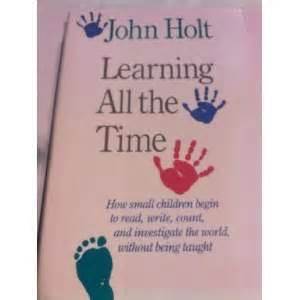
John Holt

"We learn to do something by doing it.  There is no other way."


— John Holt
American Author, Educator
1923 - 1985


Commentary
We take in information about the world outside ourselves through our senses of seeing, hearing, touching, tasting and smelling and it is through these senses that we learn.  When it comes to the classroom, we learn primarily through seeing, hearing and doing.  Usually one or two of these ways of learning will be dominate in a person, but we learn through all three ways and we can improve our ability to learn in a given way.  

How do you learn?  Are you a life-long learner?  Are you a visual learner?  Do you learn best by seeing something?  There are two types of visual learners?  Those that learn through pictures and graphics and those that learn through the written words.  Are you an auditory learner?  Do you learn best by hearing something.  Do you listen to recorded books?  Are you a kinesthetic learner?  Do you learn best by doing?


So how does this apply to the creative leader?  First, how do you best learn your craft of drawing, writing, or acting?  By reading about it?  By watching others?  Or by doing it yourself?  I think that we learn in all three ways, but we learn best by doing.  No matter how much you read, you have to pick up the brush or pen to be successful.  No matter how much time you spend watching others, you have to pick up a pen or brush.  Only in doing can you put what you learned by reading and watching into practice.   If we pay attention to what we do, we can teach ourselves many things.  Reading and watching others, though, will speed up the learning process.


How about how your audience experiences your works of art.  Do they only experience it visually?  Can they hear it?  Can they smell it or taste it?  To me I experience a story or poem differently when I hear than when I read it on a page.  When I listen to a novel while driving, I become part of the world of the novel in a way that does not happen when I read about the world on the page.  I find my others senses are more engaged when I listen to the book.  I see, smell and taste the world in ways that often don't happen when I read.

Creative Practice:
Take a test to determine how you learn best.  Here is one free test that can be found on line. 


Background on Author
John Holt, born in New York City, was the oldest of three children.  He joined the navy and fought in World War II in the Pacific.  After the war, he became a school teacher and taught in Colorado and Boston.  He published his first book, How Children Fail, in 1964.  The controversial book blamed schools for the failure of children.   His follow-up book, How Children Learn, was published in 1967.  I remember in college that I bought bought books from the Doubleday book club.  He wrote 11 books of which two were published after his death.  Holt became disillusioned with the school system and became an early proponent of homeschooling.  His book, Teach Your Own was published in 1981.


Monday, July 18, 2011

Frederick Franck

"I have learned that what I have not drawn, I have not really seen, and that when I start drawing an ordinary thing, I realize how extraordinary it is, sheer miracle."


Dutch Painter, Sculptor, Author
1909 - 2006


What we know of the world we know through our senses.  Yet, we often spend so much time in our head with our thoughts that we don't experience the world around us.  Have you ever walked past a flower, a tree or a stream a hundred times and yet know nothing of the stream, or tree or flower.  What have you missed in the world around you because you are so busy thinking about your life, your problems or your family?  When you begin to see the tree as it is, will you paint it in a different way.  Franck also said, "Drawing is the discipline by which I constantly rediscover the world."  Are you rediscovering the world around you through your drawing?

Do you hear the conversations of your friends and family members or are you so busy thinking about what you are going to say that you fail to listen to them.  A writer of dialogue must listen to the language used by the people around him.  Do you see how the people around you dress?  The way they carry themselves?  How they move about the room?  It is through the behavior we see that we find the clues to who the person is.  And it is through the behavior we describe that our readers know our characters.

Wednesday, May 18, 2011

Henry Moore


"Between beauty of expression and power of expression there is a difference of function.  The first aims at pleasing the senses, the second has a spiritual vitality which for me is more moving and goes deeper than the senses."


— Henry Moore
British Sculptor
1898 - 1986


Which is more important the beauty of what is said or the power of what is said?  I agree with Moore that the impact of what is communicated is more important than the beauty with which it is communicated.  It doesn't matter whether you are talking art, literature or music.  Too much emphasis in our culture has been put on beauty.  Form often wins out over substance.  For me, the substance of the art matters more.  The spiritual aspect of the communication is more important than the surface beauty.  Some works of art have both beauty and substance.  But if I must choose, I choose substance over beauty.  When you look at a painting, listen to music or read a novel, what is more important to you:  what is said or how it is said?


Saturday, April 23, 2011

Kimon Nicolaides

"Learning to draw is really a matter of learning to see — to see correctly — and that means a good deal more than merely looking with the eye."


American Artist, Teacher, Author
1891 - 1938


The arts involve the five senses of seeing, hearing, touch, taste and smell.  We understand the world in which we live through these five senses.  How we see the world impacts our ability to draw, paint and write.  

When I arrived home yesterday, my wife asked if I had noticed a hat hanging on one of my favorite wood statues.  I had not.  She said the hat had been there for several weeks.  My visual intake of the world around me is very selective.  I never notice the clothes people wear and I could not tell you what you were wearing yesterday.  Yet, if I visit a place I have not seen in five years, I will recognize the buildings.  

I put very little description of places and people in my writing.  And when I am reading a book with a lot of description, I tend to skip over it.

On the other hand, I am very auditory.  I can hear the slightest change in the tone of a voice.  I can hear the softest of sounds.  I cannot sleep with the radio or TV playing.  But I cannot sing worth a lick.  In fact, some people would say I am tone deaf.

How do the five senses impact your painting or writing?  Are you a visual person?  An auditory person?  How about the senses of touch, taste and smell?