Welcome!

Welcome! There are more than 900 Inspirational Quotes For Writers, Artists and Other Creative Leaders on this site.
Spend a few minutes exploring. And come back again and again for other inspirational quotes.
Showing posts with label Movement. Show all posts

Monday, April 29, 2013

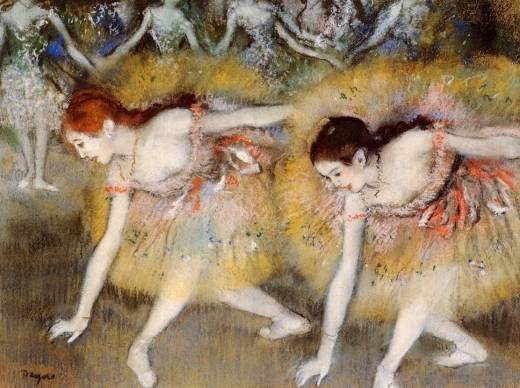
Edgar Degas


"A picture is first of all a product of the imagination of the artist; it must never be a copy . . . . The air we see in the painting of the old masters is never the air that we breathe."


Edgar Degas
French Painter
1834 - 1917


Commentary
We all need to encourage, foster and invest in our imagination.  Without imagination, most art, writing and music fail.  Imagination is what we the creators bring to the table.  All creative people have the same raw material.  How we mold and shape that material is what makes each creative person different. 

If we merely copy the work of others, then we are technicians following a pattern.  We need to alter and reshape the landscape of the world we inhabit.  We must imagine new ways of seeing.

Young children are very imaginative.  We all need to become a child again and see the world through a child's eyes.  We need to see the world as if we have never seen it before.  We need to see the world with fresh eyes untainted by experience and knowledge.

Creative Practice
This week I want you to step outside your comfort zone and explore the movement of your body.  Find a large space and where you can move about freely.  Dress in loose-fitting clothes.  Move about the space and explore the following through movement.  (You may want to watch the video below before you start.)
  • Become the color red.
  • Change into a rabbit.
  • Become light blue.
  • Fly like an eagle.
  • Become the color green.
  • Climb like a monkey.
  • Become the tree the monkey is climbing.
  • Become bright pink.
  • Become a runner who has just finished a marathon.
  • Become the bride walking down the aisle to her future husband.
Now, sit down and write for 30 minutes.  After you have finished writing, ask yourself what you learned through this process.  How did the movement influence your writing?


Background of Artist
Edgar Degas was born in Paris, France, the eldest of five children of a modestly wealthy family.  His mother died when he was thirteen.  He began painting at a young age.  His father wanted him to study law, but he did not apply himself to his studies.  He entered art school when he was twenty.  He also spent three years in Italy studying the Italian masters. In 1872 he traveled to New Orleans, Louisiana where his Creole mother was from.  He lived with relatives for a short period of time.

Degas is often identified with the Impressionists, though, he did not identify himself in that way.  He preferred to be called a realist.  His style showed a deep respect for the old masters whom he copied well into middle age.  He began by painting conventional historical paintings such as the Daughter of Jephthah (1859 - 1861) and the Young Spartans (1860 - 62).  In the late 1860's, Degas shifted his subject matter from historical events to contemporary life.  He painted women such as milliners and laundresses at work.  In 1868 he exhibited the first of his paintings of dancers.  More than half his creative output is of dancers.


Video
One of the most powerful classes I have ever taken was a class in in creative drama where we explored the world around us through our bodies.  In order to portray a character, actors have to have immense imagination.  Watch this video of a acting class.


Monday, October 15, 2012

Friedrich Nietzsche


"When my creative energy flowed most freely, my muscular activity was always the greatest. . . . I might might often have been seen dancing; I used to walk through the hills for seven or eight hours on end without a hint of fatigue; I slept well, laughed a good deal—I was perfectly vigorous and patient."


— Friedrich Nietzsche
German Philosopher, Poet, Composer
1844 - 1900


Commentary:
What is the connection between movement and creative energy?  When sitting at my desk writing, I often have the urge to stand up and walk around.  Sometimes I am able to control this urge while on occasion my subconscious takes over and I suddenly find myself walking around.  I also find that some of my most creative thoughts come when I am taking a walk in the early morning.

For the past 25 years I have been teaching a 2 - 3 day workshop in which students sing and dance 4 to 5 times.  Now the dance is not really dance but more physical movement.  The impact on the classes has been amazing.  During the course of workshop people become bonded and connected.  The normal barriers between people fall away and people willingly share about their lives. 

A few years ago I took a class that combined movement, journey and creativity.  We were encouraged to move about an open room with no chairs and find our place in that room — our home.  Then we were asked to find some destination — some place we wanted to go.  And we were to create a path around the room to that point.  We were to move along that path multiple times until it became very familiar to us.  We were also to express our feelings through writing while on this journey.  I found the workshop fascinating.

Years ago when I was only writing haiku, I would take walks during which I would write one or two haiku in my head.  When I reached home, I would write a narrative about my walk and include the haiku.  This type of writing is called haibun and was first written in 17th century Japan by Matsuo Basho.

Creative Practice:
Take a fifteen minute walk and sit down and write for 15 minutes about anything that comes to mind.  Don't stop.  Keep writing.  Don't worry about grammar or spelling.  Repeat this process multiple times during the week.

About the Philosopher:
Portrait of Friedrich Nietzsche
Edvard Munch
1906
Friedrich Nietzsche was born 168 years ago on October 15, 1844 to Carl Nietzsche and Franziska Oehler in Rocken, a small town near Leipzig.  He was named after King Frederick William IV of Prussia who turned 49 on the day of Nietsche's birth.  Nietzsche's father died when he was five.

In 1864, Nietzsche began studying theology and philology at the University of Bonn.  Within a year, he lost his faith and stopped his theological studies.  He wrote his deeply religious sister: "Hence the ways of men part: if you wish to strive for peace of soul and pleasure, then believe; if you wish to be a devotee of truth, then inquire. . ."  He focused his attention on philology.

In 1868, Nietzsche became a professor of classical philology at the University of Basel in Switzerland.  Before leaving Prussia, he renounced his Prussian citizenship and remained officially stateless for the rest of his life.  Nietzsche published his first book, The Birth of Tragedy, in 1872.  The book was poorly received by his colleagues in the philological field.  He resigned his position as professor in 1879 because of health issues.

In 1889, Nietzsche suffered a mental collapse.  In 1898 and 1899, Nietzsche suffered two strokes and was partially paralyzed and unable to speak.  He had another stroke on August 24 and died on August 25, 1900.

Nietzsche is known for his use of poetry and prose in his writings.  Nietzsche was not widely read in his lifetime.  Because of his evocative style, people either love or hate his philosophy and his work even today is very controversial.  Nietzsche's best known writings include: Thus Spoke Zarathustra, Beyond Good and Evil, and The Will to Power.

Poem

Without a Home

Swift horses carry me
Without fear and trembling
Through the distant land.
And whoever sees me, knows me,
And whoever knows me, calls me:
The homeless man ...

No one would dare
To ask me about
Where my home is:
I have never been bound
To space and fleeting time,
Am as free as an eagle! ...


Biography Source:
http://en.wikipedia.org/wiki/Friedrich_Nietzsche

Quote Source: 
Anne Dillard, The Writing Life, p. 33 - 34.

Friday, February 25, 2011

Havelock Ellis

"Dancing is the loftiest, the most moving, the most beautiful of the arts, because it is no mere translation or abstraction from life; it is life itself."


British Physician, Writer, Psychologist
1859 - 1939


Dancing has never been my strong suit.  I grew up in a church where dancing was considered a sin.  I sinned in the seventh grade when I danced at a sock hop, but I have never felt comfortable dancing.  I have no rhythm. 

 I have learned that dancing is an art that touches the soul.  While I may never have rhythm, I can appreciate it in others.  I took a movement class 5 years ago that used movement to explore your purpose in life.  We created our life story through movement.  Some day I would like to participate in a workshop that combines dance, painting, storytelling and writing.  Who knows maybe I will create it myself.