Welcome!

Welcome! There are more than 900 Inspirational Quotes For Writers, Artists and Other Creative Leaders on this site.
Spend a few minutes exploring. And come back again and again for other inspirational quotes.
Showing posts with label Power. Show all posts

Monday, April 4, 2016

Louis Auchincloss — The Gift of Dreams


How often do we hold ourselves back from doing the things we want to do because we are afraid? Afraid of what others will say? Afraid of failure? Afraid of success? Afraid we don't have any talent?

Louis Auchincloss wrote this statement in his first memoir, A Writer's Capital, in 1974. In his 92 years on this planet, Auchincloss was a lawyer, a novelist, a short-story writer and a historian, publishing more than 60 books. He filled his life with things he wanted to do.
Dreams are creative gifts we have been given — paths that we should walk.  When we refuse to seek our dreams and refuse to do the work that needs to be done, we are rejecting the gift. We are denying our birthright. 

Is there something you have been dreaming of doing, but have not done it? Maybe today it is time to take that first step in achieving your dreams. If you don't, no one will care. Only you care about your dreams. Only you can achieve your dreams. Only you have the power it takes to achieve your dreams.

Today I celebrate my 67th birthday. I am thankful for the gifts I have been given — the dreams that I followed and the life I have lived.

Monday, August 6, 2012

Natalie Goldberg

"It is important to remember we are not the poem.... The power is always in the act of writing.... Write good poems and let go of them.  Publish them, read them, go on writing."


American Writer, Artist
1948 -


Message to followers
Two years ago tomorrow, I began this blog.  I have spent between 5 - 7 hours a week producing it.  This amounts to over 25o hours a year.  There are now over 700 quotes on this site that are designed to inspired creative leaders, including writers, artists, musicians and actors.  When I started, my goal was to write the blog daily for a year.  Unfortunately, the time I have spent on this blog has taken time away from my personal writing.  One option would be to close the blog down, but I believe the messages I have been sharing are important to others.  I have decided instead to change it from a daily blog to a weekly blog. So beginning with this entry, I will be publishing the blog every Monday morning.  And I have changed the name to Monday Morning Motivation.  Please come back every Monday for your dose of inspiration and motivation.

Commentary
Natalie Goldberg has had a powerful influence on my writing.  I have read all of her books on writing and continue to reread them.  I highly recommend that every new writer read her books.  

We are not our writing or our painting.  Don't get caught up in confusing your identity as a person with the identity of the people in your writing.  The power is always in the act of creation, not in the final product.  Enjoy and appreciate the creative process.  That is where you will learn the most about yourself.

About the Author
Natalie Goldberg is an American poet, painter, teacher and author.  She has written 12 books including Writing Down the Bones: Freeing the Writer Within which has been translated into 14 languages.  She has written several memoirs including The Great Failure and  Long Quiet Highway.  She currently lives in northern New Mexico.

Quote Source:  Writing Down the Bones by Natalie Goldberg, p. 32 - 32.

Wednesday, February 8, 2012

Herodotus

"Some give up their designs when they have almost reached the goal; while others, on the contrary, obtain a victory by exerting, at the last moment, more vigorous efforts than ever before."


Greek Historian
484 BC - 425 BC


The one trait that every writer, painter and musician needs is persistence.  Without persistence and determination, most creative people will quit before they are successful.  People often give up too soon.  They forget that the night is the darkest just before the dawn.  When every things appears to be lost that is the time to push the hardest — to exert that extra effort.

Most successful artists and writers throughout history have understood the power of persistence.  Herodotus said it more than 2500 years ago and nothing has changed.  You still need persistence to be a winner — to be successful.  The world is full of obstacles and naysayers.  It takes persistence to find a way around or through the obstacles.  Don't give up on your dreams and hopes.  

Wednesday, January 18, 2012

Raymond Chandler

"Technique alone is never enough.  You have to have passion.  Technique alone is just an embroidered pot holder."


American Novelist
1888 - 1959


Are you passionate about you create?  Are you passionate about your subject matter?  Are you passionate about your medium?  Technique without passion is cold and empty and rarely touches the hearts of people.  Passion without technique still has the power to bring people to tears.  Passion with technique is great art.  Have you perfected your technique?  Have you encouraged and cultivated your passion?  What are you passionate about?  What keeps you awake at night?  What fills your spirit with love?

Friday, December 23, 2011

John Keats

"I am certain of nothing but the holiness of the Heart's affections and the truth of imagination."


English Poet
1795 - 1821


One of the most powerful forces available to creative leaders is their imagination.  Your imagination will open up new worlds and provide you answers to many of the challenges you face in your creative work.  You must learn to cultivate your imagination.  You must nurture it and feed it.  Imagination grows through exposure to various ideas and various experiences.  


Steve Jobs, after dropping out of college, audited a course on calligraphy because he was interested in the subject.  What he learned in that single course gave rise more than a decade later to the multiple fonts available on the Mac computer.  And since Windows adopted much of its style and look from Mac, the computer world was given an array of fonts from which to choose.  How much different life would have been if computer users could not change fonts.


What are you doing to expand your imagination?  What ideas are you exposing yourself to?  How are you growing your imagination.  If you don't use it, you may lose it.  Feed your imagination today.

Sunday, August 21, 2011

Keith Harrell

"Challenges — life is full of them; without them, how would you know and realize the awesome power that lives within you."


Keith D. Harrell
American Speaker
1956 - 2010


We all face challenges in life.  No one ever lives a life without some challenge.  For some of us, the challenges seem to be overwhelming.  I don't know how I would survive living in a war zone or a prison.  In many ways, I feel blessed because I have had fewer challenges than some.  But I have also had more than others.  I think the first mistake is to compare my challenges to those of others.  It does no good.  

What is more important is what we learn from the challenges we face.  What do our experiences teach us?  How have our challenges made us better artists and writers?  How can we use our challenges?  Our challenges can help us find that hidden strength that we all have within us.  We are stronger than our challenges.  So the next time you have a challenge in your life.  Be thankful for what you are about to learn.  Be grateful for the gift of learning that you have been given.

Wednesday, August 10, 2011

David McNally

"The circumstances of our lives have as much power as we choose to give them."


American Speaker/Author


The circumstances that we find ourselves in — being poor or rich, educated or high school dropout, being married or single, being published or not — only have power to influence how we feel if we choose to give them that power.  We did not have control over the fact that we were born into a family that was poor, but we do have a choice about how we will respond to our circumstances.  We have no control over how others respond to our painting or writing, but we do have a choice about how much influence the opinions of others have on us.

I had an opportunity to hire David McNally to speak several years ago.  I was impressed with his story about making a documentary film about Terry Fox, a young Canadian who ran 3/5 of the way across Canada and raised 24 million dollars for cancer.  McNally had no experience making a film but was inspired to tell Terry's story of purpose.

At the age of eighteen, Terry Fox was diagnosed with cancer and had his leg amputated.  Instead of wallowing in self-pity, he decided to find some purpose in what had happened to him.  His goal was to run across Canada and raise a million dollars for cancer research.  He made it 3/5 of the way before he became too sick and had to stop.  He died a short time later.  McNally movingly tells Terry's story in the film, The Power of Purpose.

The circumstances that we find ourselves in — being sick or healthy, employed or without a job, homeless or with a roof over our heads — only have the power to influence how we feel if we choose to give them that power.


Wednesday, May 18, 2011

Henry Moore


"Between beauty of expression and power of expression there is a difference of function.  The first aims at pleasing the senses, the second has a spiritual vitality which for me is more moving and goes deeper than the senses."


— Henry Moore
British Sculptor
1898 - 1986


Which is more important the beauty of what is said or the power of what is said?  I agree with Moore that the impact of what is communicated is more important than the beauty with which it is communicated.  It doesn't matter whether you are talking art, literature or music.  Too much emphasis in our culture has been put on beauty.  Form often wins out over substance.  For me, the substance of the art matters more.  The spiritual aspect of the communication is more important than the surface beauty.  Some works of art have both beauty and substance.  But if I must choose, I choose substance over beauty.  When you look at a painting, listen to music or read a novel, what is more important to you:  what is said or how it is said?


Thursday, April 21, 2011

Robin Moore

"To truly own a story, you must fashion it and shape it, as you would a garment, to fit your frame."


American Storyteller, Writer
1950 - 


Do you own the stories you tell with your art?  Do the stories you tell touch your heart?  Do they bring tears to your eyes?  Art is about communicating emotion through the stories we tell.  Reach deep inside your soul and touch the power of who you are.  Show us the love you feel.

During the last thirty years there has been a rebirth of oral storytelling in the United States.  Robin Moore has been one of the leaders of this storytelling movement.  For me, there is a lot to be said about the oral tradition.  Prior to the invention of the printing press, storytelling was how people shared information and entertained each other.  And while I love the printed word and average reading about two books a month, I find something exciting about listening to a well told story that makes me laugh and cry.

In the final analysis when we look back across our lives all we have are our memories and our stories.  The jobs we hold and the money we make have little value when our days on the planet are coming to a close.  As a creative leader, you should mine your experiences for stories to share in your paintings, your poetry and your novels. 

Here is Robin Moore talking about story and community.


Friday, April 15, 2011

Rita Dove

"Poetry is language at its most distilled and most powerful."


American Poet
1952 - 


If you stripped your art down to the bare bones, what would be left?  A line? A word?  An emotion?  If you look at the history of the arts, you will notice that artists vacillate between extravagance and simplicity, between embellishment and bare bones.  My style has been one of simple speech, with few big words or large flourishes.  If you distilled your art down to its essence, what would you find?  What is at the core of your art?

April is poetry month.  Here is a poem by Rita Dove.


"Teach Us To Number Our Days"

In  the old neighborhood, each funeral parlor
is more elaborate than the last.
The alleys smell of cops, pistols bumping their thighs,
each chamber steeled with a slim blue bullet.

Low-rent balconies stacked to the sky.
A boy plays tic-tac-toe on a moon
crossed by TV antennae, dreams

he has swallowed a blue bean.
It takes root in his gut, sprouts
and twines upward, the vines curling
around the sockets and locking them shut.

And this sky, knotting like a dark tie?
The patroller, disinterested, holds all the beans.

August.  The mums nod past, each prickly heart on a sleeve.


(By Rita Dove from Yellow House on the Corner, Carnegie Mellon University Press, 1989)

Here is Rita Dove reading another of her poems.


Monday, April 11, 2011

The Power of Words

Do you believe in the power of words to change people?  Watch this.


Monday, March 7, 2011

Mother Teresa

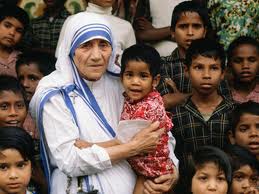
"It is not what we do, it is how much love we put in the doing."


Catholic Nun
1910 - 1997


Do you put love into what you do?  As creative leaders we should love the process of creating.  The more love we put into our work; the more creative the end product is.  If you don't enjoy the process, then why do you do it?  Are you doing it for the wrong reasons?  For money?  For fame?  For sex?

Some writers and artists struggle to produce work.  I once read about a writer who published his first novel in his thirties and didn't publish his second until he was in his eighties.  For some people the creative process is difficult work.  I suggest you put love into your work and you might find it more enjoyable and less painful.  The journey we take is often more important than the destination.  We find out who we are and why we are here through the process of creating.  

The process of creating is a form of prayer — a connection to a power beyond ourselves, to a purpose bigger than us.  When we lose connection with this creative force, we stumble and struggle to create.  Writers and painters both talk about being in the flow — of something greater than themselves actually taking control and doing the creating.  They are only the instrument in the hands of the creative force.  They connect through love.

Saturday, February 26, 2011

Gloria Steinem

"Without leaps of imagination or dreaming, we lose the excitement of possibilities.  Dreaming, after all, is a form of planning."


American Journalist, Author
1934 - 


Most of us underestimate the power and importance of dreaming — whether we are talking about day dreaming or sleep dreaming.  Sleep dreaming is one of my favorite times, especially in the twilight world between being awake or being asleep.  Dreams can feel so real and meaningful.  Years ago I kept a dream journal where I would record my dreams.  I have documented proof that I dreamed of marrying my wife a month before I met her.  So I do believe that dreams can predict the future.  I have experienced the excitement of possibilities.  Dreams are small windows into our souls.  

Day dreaming is a way to explore your options and find the right path.  Day dreaming helps creative leaders make decisions and take action.  As Steinem says, day dreaming is a form of planning, a way of preparing for what is to come.  Our minds are very powerful and we can see things our mind's eye before they happen.

Have you ever gone to sleep thinking of some problem and wake up with the answer?  You need to learn to harness the power of your dreams to help you creatively solve problems.  You need to increase your involvement with dreams.  My wife at a very young age discovered that she had the ability to consciously change her dreams.  If she did not like where her dreams were going she would change them while dreaming.  Today we call it lucid dreaming. 


Thursday, February 3, 2011

Carol Emshwiller

"Stories do not change the world.  I've learned that.  But perhaps in some secret, subtle way . . . . I mean it's not the world I want to change."


American Novelist
1921 -


Sometimes as creative leaders, we hope we can change the world — to make it a better place for everyone.  Unfortunately, our vision of what we want the world to be and what it actually is rarely match.  And even the most powerful of people can not change the world to fit their vision.  We can have an impact on the lives of some people and can alter the small corner of the universe where we eat and sleep.  Maybe as Emshwiller says, we need to lower our sights.  If I touch one heart, changed one life, I have made a powerful difference.


If I want to change the world that I inhabit, I must first change myself.  As creative leaders, we must first work on becoming who we need to become before we change those around us.  It is very difficult to change someone else.  Husbands and wives understand this.  Those who learn to accept their spouses for who they are will be happily married.  Those who spend all their time trying to change the behavior of those they love, often end up bitter and angry.

Change is something that we enjoy when we are the ones who initiate it.  If someone else tries to change us, we put our foot down and refuse.  As creative leaders, our art, writing and music can touch people's lives and inspire them when they are ready to hear and see.  We all plant seeds and yet, may never hear if the seeds grow and bear fruit.  So we must hope that we have changed a few.

Thursday, October 21, 2010

William James

"Be not afraid of life.  Believe that life is worth living, and your belief will help create the fact."


American Writer/Philosopher
1842 - 1910


Every person is unique.  There has never been a person just like you and there will never be a person just like you.  The life you lead is yours.  Nobody can lead the same life and do the same things, so that makes you special.  

Do not judge yourself by how much money you make or how much power you have or the creative work you produce.  Your success lies in the lives of the people you have touched.  And if that is only one person, then you are a success.  All of us in some way will touch the lives of our parents and our siblings.  So from the moment we are conceived, each of us is successful.

Saturday, October 2, 2010

John F. Kennedy

"When power narrows the area of man' concern, poetry reminds him of the richness and diversity of his existence."


American President/Writer
1917 - 1963


This is a fascinating quote from one of the most powerful and famous people in the 20th century.  The wielding of power narrows one's focus.  We usually think the reverse of people with power.  They can do anything they want.  But Kennedy is saying that power actually limits what you focus on — what you are engaged in.   Poetry, for Kennedy, served the purpose of broadening his focus and open up new worlds of understanding.  And I think art, music, and novels do that as well.  Our jobs tend to keep us focused on a narrow group of topics.  Reading books, listening to music and observing art can carry us out of ourselves to other worlds.