Welcome!

Welcome! There are more than 900 Inspirational Quotes For Writers, Artists and Other Creative Leaders on this site.
Spend a few minutes exploring. And come back again and again for other inspirational quotes.

Monday, April 14, 2014

Marc Chagall

"If I create from the heart, nearly everything works, if from the head, almost nothing."


Russian Artist
1887 - 1985


Commentary
Sometimes the mind gets in the way of creativity.  We are constantly talking to ourselves about our work and usually this self-talk is very negative.  "Oh, I shouldn't say that.  What will my mother say?"   Or "I am no good at painting faces."  One expert says that 75% of what we say to ourselves is negative and this negativity hurts our ability to create.  

We need to learn to use positive self-talk, to appreciate the talent and skills we have been given.  We each are unique.  No two people are alike.  We all have different skills, interests and beliefs.  We need to pat ourselves on the back.  

I and the Village
(1911)
Since there are enough negative people in the world who will put us down and criticize our work, we don't need to do it to ourselves.  I challenge you to listen to your self-talk and whenever it is negative, change it and make it positive.  Become a believer in the talent you have been given.  Choose to be positive — to find the rainbow in every dark cloud.

When I first became a speaker, I used positive self-talk to overcome my fear and doubt about standing up in front of others.  I repeatedly said positive comments out loud prior to going on stage.

Where do you need more self-confidence?  What changes in behavior do you want to make?  Use self-talk to become the person you want and need to become.  You can change who you are by changing what goes into your mind.


Biography

La Mariee
(1950)
Marc Chagall was born Moishe Shagal in Vitebsk, Russia, the eldest of nine children born to Khatski Shagal, a herring merchant and his wife, Feige-Ite.  Shagal was educated at a Jewish religious school where he studied Hebrew and the Bible.  There was no art in his home and the concept was unknown to him.  In high school, he saw a fellow student drawing and became interested.  He began to copy the work of the masters that he found in books.

At nineteen, Chagall moved to St. Petersburg, then the capital of Russia, and spent four years studying painting.  In 1910 he moved to France at the age of 23.  He returned to Russia in 1914 planning to only stay a few weeks, but World War I intervened.  He stayed in Russia and married Bella Rosenfeld.  Chagall exhibited his paintings in Moscow and St. Petersburg.  He became a stage designer for a theater in Moscow.  In 1923, he returned to France.  In 1926, an exhibit of his work was held in the United States.  He escaped France during World War II and entered the United States.  He returned to France in 1948 where he remained until his death.

Video
Here is a video of Chagall's paintings.


Monday, April 7, 2014

Barry Lopez

Photo by David Liittschwager

"The stories people tell have a way of taking care of them.  If stories come to you, care for them and learn to give them away where they are needed.  Sometimes a person needs a story more than food to stay alive. That is why we put these stories in each other's memories."


— Barry Lopez
American Writer
1945 -


Commentary
Do you care for the stories in and about your life?  Stories are the memories of who we are and where we have gone.  Stories remind us of what is important and what we want to remember.  Do you take care of your family stories, those tales that create the collective you?  Each time I share a story I am giving a piece of myself away.

One of those stories that circulated in my family was the time when I was six or seven and lived on a farm. My father was working the second shift at a factory because the farm did not give us enough money to live on.  One summer afternoon after my father had left, the cows meandered out into the cornfield.  Now this can be dangerous for the cows because they don't know when to stop eating and they could kill themselves by eating too much corn.  My mother and I attempted to chase the cows back into the barn but were unsuccessful.  She went into the house to call my father and have him come home from work.  She told me to come in as well and leave the cows alone.  I prayed to God and asked that He helped me drive the cows back to the barn.  And by some miracle, I did.  God answered my prayer.  What I have never understood is why the prayer was answered when the result was I disobeyed my mother.  That story has circulated within my family for years and gave me the impression that I had a special connection to God.  That connection was broken when I was seventeen, but that is a story for another time.

What are your family stories?  What are the tales that have helped to create the person who you are?  What stories are you repeating over and over to people?  What stories are you hiding that you have been unwilling to tell?  What stories do you need to change because they are hurting you and holding you back from becoming who you want to become?  Are you taking good care of your stories?  Have you written them down?  Made them available to others?

Biography
Barry Lopez was born in Port Chester, New York and raised in both New York City and Southern California.  He graduated from the University of Notre Dame.  He currently lives in Oregon where he moved in 1968.  Lopez has traveled to remote and populated areas of the world.

Lopez is an essayist, author and short-story writer.  He has received the National Book Award for his book, Arctic Dreams, and was a National Book Award finalist for his book, Of Wolves and Men.

Prior to 1981, Lopez was also a landscape photographer and still maintains a close connection with various artists and photographers.

Here is a link to his website:  http://www.barrylopez.com/index.htm

Video
Here is a video with Barry Lopez.


Monday, March 31, 2014

e. e. cummings

Self-Portrait
1939
"most people are perfectly afraid of silence"


American Poet/Artist
1894 - 1962


Commentary

e. e. cummings
1933

Writers and artists require silence to focus on their work and, yet, many people are afraid of silence.  Silence helps us find our way through the maze of life.  Silence opens like a flower in the morning.  Take time to enjoy the silences of your life.  The hardest silence to find is the silence of the mind.  We are constantly talking to ourselves even when we have silenced the voices around us.  Learn to slow your mind down and quiet the voices talking inside your head.    Rid yourself of your mother's voice.  Your father's voice.  The voice of the critic.  The voice of the editor.  Learn to love silence. 


Biography
Edward Estlin Cummings was the oldest child of Edward Cummings and Rebecca Haswell Clarke.  His artistic talents were present from an early age.  His mother preserved many of his drawings of animals from his early childhood.  He wrote his first poems at the age of 3 with his mother serving as scribe.  He was reading at four.  He compiled his first book of poems at age 12 and his second collection at age 14.  His first published poem appeared in the Cambridge Review when he was 15.  In the summer of 1910 he wrote a poem a day.

In the fall of 1911, a couple months shy of his 17th birthday, Cummings entered Harvard College as a freshman.  In 1913 he acted in a play along side then graduate student T. S. Eliot and won the affections of the girl they both pursued.  Cummings graduated from Harvard in June of 1915 and delivered one of the graduated speeches on the new art.

Cummings pursued the twin arts of painting and poetry throughout his life. Best known for his poetry, Cummings also published two novels and four plays. His paintings can be found online at http://www.eecummingsart.com/ .

Video:
My favorite poem by e. e. cummings is anyone lived in a pretty how town. Here is Cummings reading the poem.


Monday, March 24, 2014

Henri Matisse

"Creation is the artist's true function; where there is no creation there is no art."


French Artist
1869 - 1954


Commentary
Most of us are drawn to the arts because of a need to create something, to express what we are feeling.  Those who stay involved with some art form, such as writing, painting or acting, must also learn technique, but if in the study of techniques we forget creativity, we have lost touch with the purpose of art.  Creativity is the very heart of what we do.  The mastery and perfection of technique must never be more important then the creative impulse.  The art we create must be fresh and new, not boring and repetitious.

Matisse, Woman With A Hat, 1905
Biography
Henri Matisse was born in northern France, the eldest son of a grain merchant.  At 18, he moved to Paris to study law.  At 20, he had an appendicitis attack and while recovering took up painting because his mother gave him art supplies to keep him from being bored.  When Matisse decided to study art instead of law, his father was very disappointed.

Matisse is best known for his use of color and his original draughtsmanship.  While he was a printmaker and sculptor, he is best known as a painter.  His creative work spans more than half a century and he is considered one of the leading painters in modern art.

Video
Here is a documentary about Henri Matisse.


Monday, March 17, 2014

Claude Monet

Painting of Monet
by Auguste Renoir
1875
"I perhaps owe having become a painter to flowers."


— Claude Monet
French Painter
1840 - 1926


Commentary
Why did you become a painter, a writer or a storyteller? Why did you start playing music and composing songs? Why do you love to take photographs? What drives you to be creative? What is your story? I began writing poetry when I was a junior in high school and I submitted my early poems as a paper for a social studies seminar. My English teacher asked me why I had not shown them to her. At the time I had not made the connection between writing and English class. I wrote because it was a way to express my ideas on societal problems. Why are you an artist? I'd love to hear your story.

File:Claude Monet - Water Lilies - 1906, Ryerson.jpg
Water Lilies 1906
Biography
Claude Monet was born in Paris, France to Claude Adolphe Monet and Louise Justine Aubree Monet.  He was baptized as Oscar-Claude but his parents called him Oscar.  His father wanted him to enter the family grocery business but Monet wanted to be an artist.  When he was sixteen his mother died.  Monet moved to Paris and lived with his widowed, childless aunt.

When Monet was twenty, he joined the First Regiment of African Light Cavalry in Algeria.  He was committed to serve for seven years but was discharged after two years because he had contracted typhoid fever.  

Woman in a Green Dress
by Claude Monet
Model is Camille Doncieux
1866.
In 1867, Camille Doncieux, a model, gave birth to Monet's first child.  They were married in 1870.  In 1879, Camille died from cancer at the age of thirty-two.

Monet was a founder of the Impressionist movement in France and was one of its most consistent and prolific artists.  The first Impressionist exhibition was held in 1874.  Renoir chaired the hanging committee and did most of the work himself.  Monet showed 11 paintings in the collection of 165.

Monet died of lung cancer at the age of 86.

Monday, March 10, 2014

Paul Gauguin

"Poor artist!  You gave away part of your soul when you painted the picture which you are now trying to dispose of."


French Artist
1848 - 1903


Commentary
Tahitian Women on the Beach
1891
The yin and the yang for most creative leaders is the conflict between the passion for creating and the need to eat, between time spend creating and time spend selling.  How do we balance these two opposites?  

Most of us would prefer to paint, to write and to compose, but we also have the need to feed our families and to a lesser extent ourselves.  Some people take jobs teaching.  Others work in business.  The poet Wallace Stevens spent his career as a lawyer for an insurance company.  How do you balance the need for creating art and the need for cash to live?

Biography
Paul Gauguin was born in Paris, France to a French journalist and the daughter of an influential Peruvian family.  When Paul was two, his family moved to Peru.  His father died on the voyage.  When he was seven, his mother returned to France with his sister and him to live with the paternal grandfather.  Paul's first language was Peruvian Spanish.  He also learned French.

Paul joined the French navy and was at sea when his mother died.  Upon returning to France, Paul became a successful businessman.  At 25, he married a Danish woman and they had 5 children in ten years.  In 1884, Gauguin moved his family to Denmark, the home of his wife, and tried to sell tarpaulins but failed.  His wife supported the family by giving French lessons.  His marriage failed and he returned to Paris in 1885.  

In 1873, Paul also took up painting in his spare time.  He frequented cafes where he found other artists.  He visited art galleries and purchased paintings by emerging artists.  He formed a friendship with Pissarro who introduced him to other painters.  He spent 9 weeks painting with van Gogh in 1888 in Arles, France.  He also traveled to Martinique and Tahiti. Both places influenced his paintings.

Video:
Here are some of Paul Gauguin's paintings.  Enjoy.


Monday, March 3, 2014

Irving Stone

"Art is a staple, like bread or wine or a warm coat in winter.  Man's spirit grows hungry for art in the same way his stomach growls for food."


American Novelist
1903 - 1989


Lust for Life
A novel about the life
of Vincent Van Gogh
Commentary
Many people treat the creative spirit as a luxury, something that is not needed to live life.  And they are quite wrong.  Creativity is a crucial part of living.  If I did not have an outlet for my creativity, I would either go crazy or die.  Creativity is at the very core of who I am.  If I go too long without writing, without putting words on paper, I begin to feel a hunger growing inside me.  I have a strong need to create, to produce something either through writing or painting.  It is as important to my life as water, air, food, shelter and companionship.  Without it my spirit would shrivel and die.  We need food for the body and food for the spirit.  Creativity provides the food for the spirit.

Biography
Irving Stone was born Irving Tannenbaum  in San Francisco, CA.  When he was seven, his parents divorced.  When he was a senior in high school, his mother remarried and Irving legally changed his last name to that of his stepfather.  His mother instilled in him a passion for reading.  He received a bachelor's degree from Berkeley in 1923 and his masters from the University of Southern California in 1924.  In the early writing years he supported himself by writing detective stories.  He married Jean Factor, his editor, 1934.

Irving Stone is one of his best known for his biographical novels.  He called them bio-histories.  His first novel, Lust for Life, about the life of Vincent Van Gogh was published in 1934 after being rejected by 17 publishers.  Lust for Life is probably his best known and most famous novel.  Stone did exhaustive and detailed research of the lives of his famous characters, reading original letters and documents.  Several of his novels have been made into movies.

Besides Van Gogh, Stone wrote novels based on the lives of Jack London, Clarence Darrow, Earl Warren, Eugene Debs, Michelangelo, Sigmund Freud, Charles Darwin and Camille Pissarro.  He also wrote three novels based on the marriages of three American presidents: Andrew and Rachel Jackson, Abe and Mary Lincoln, and John and Abigail Adams.

Video:
Here an interview with Irving Stone.  He is very articulate.


Monday, February 24, 2014

Pat Barker

"When I'm writing the first draft, I'm writing in a very slovenly way: anything to get the outline of the story on paper."


Pat Barker
English Novelist
1943 -


Commentary
Do you worry about that first draft?  Do you want every word to be perfect?  Creativity is messy.  It is like the tide, ebbing and flowing, washing the sand away and bringing it back again.  No creative writer is able to create a perfect first draft.  Yet, many of us berate ourselves because the first draft is full of grammatical and spelling errors.  First drafts should be sloppy and full of wrong roads taken and misadventures survived.  The first draft should be fun to create.  You are an explorer in a previously unknown world.  Let yourself go down dead end rabbit holes.  Your first draft should be filled with mistakes.

Biography
Pat Barker was born in England to a working class family during World War II.  Her mother was unmarried and the pregnancy resulted from a drunken night out on the town.  She and her mother lived with her grandparents until she was seven when her mother married.  She chose to remain with her grandparents instead of going with her mother and stepfather.  After high school, she studied international history at the London School of Economics.

Barker began writing fiction in her mid-twenties.  She never published the first three novels that she wrote.  Her first published novel, Union Street, appeared in 1982 when she was almost forty.  Blow Your House Down was published in 1984 and The Century's Daughter in 1986.  All three novels dealt with English working class women.

Pat Barker is best known for three novels about World War I:  Regeneration (1991), The Eye in the Door (1993) and The Ghost Road (1995).  The novels are a blend of history and fiction and include the British soldier-poets, Wilfred Owen and Siegfried Sassoon as main characters.

Video
Here is a video about  Regeneration.


Monday, February 17, 2014

Jim Rohn

"Discipline is the bridge between goals and accomplishment."


American Author, Motivational Speaker
1930 - 2009


Commentary:
We all have dreams and goals but many of us never achieve them because we have not mastered the art of self-discipline.  I define self-discipline as sacrificing short-term pleasure for the achievement of long-term goals.  If you want to be a novelist but you never seem to find the time to write, you will never write your novel.  If you want to be a painter but spend your time partying with friends and not painting, you may never produce any great paintings.  The arts require a lot of self-discipline.  We need to be able to sacrifice the pleasure of the moment for the achievement of long-term success.

Creative leaders can become easily sidetracked by the next creative thought or the next creative idea.  We are attracted to the energy within new creative ideas.  It is a emotional high and can be addictive.    If we are not careful we will jump from one idea to the next and never finish what we have started.  Creative leaders must master the art of self-discipline if they are to be successful.

Are you struggling with your dreams or have you mastered the art of self-discipline?  Do you procrastinate and never finish what you start or do you bring your projects in on time?  Do you let the pleasure of the moment keep you from doing the work you were meant to do?  Do you let the joy of new ideas get in the way of completing your work?  Remember self-discipline is the key to your success. 

Biography
Emanuel James Rohn was born in Yakima, Washington to Emanuel and Clara Rohn.  He was raised on a farm in Caldwell, Idaho.  At the age of 25 he became a distributor for AbundaVita.  Two years later he quit and signed up to distribute Nutri-Bio where he was mentored by John Earl Shoaff.  He built one of the largest multi-level organizations in the company and was made a Vice-President of the company because of his performance.

In the 1960's he left Nutri-Bio and became a speaker and seminar leader.  In the 1970s Rohn conducted seminars for Standard Oil.  He spent more than 40 years presenting seminars.  He has mentored and influenced Tony Robbins, Mark Victor Hansen, Jack Canfield, and Brian Tracy.  Rohn received the 1985 National Speakers Associaton CPAE Award of Excellence.  He shared his message with over 6,000 audiences and over 5 million people worldwide.

Video:
Here is Jim Rohn: 


Monday, February 10, 2014

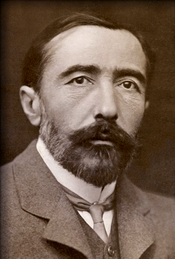
Joseph Conrad

Joseph Conrad.PNG"I don't like work — no man does — but I like what is in work: the chance to find yourself."


Polish Novelist
1857 - 1924


Commentary
Unlike Conrad, I do like to work.  I find that if I don't work I become bored and more tired than when I work.  Although, I do from time to time find myself procrastinating, particularly with creative work.  The creative side of me doesn't want to sit down and do the work.  But I strongly agree with the second half of the quote.  Work does give me a chance to explore who I am as an artist and writer.  Work helps me to understand myself better and to appreciate my talents and gifts.  Work also challenges me and pushes me to go farther than I thought possible.

I believe we ought to celebrate work.  All work is honorable if approached with the right attitude.  Housework and housekeeping is very important work.  So is child-rearing.  Raising and educating the next generation is probably the most important work of all.  I am in awe of people who are knowledgeable about the work they do.  When I meet a sales clerk in a store who knows his product, I compliment him.  I love to listen to the sales pitch of great sales people.  Sometimes I buy and sometimes I don't, but I enjoy the ride.  I celebrate people who work their hands — carpenters, farmers, mechanics.  I am not good with my hands because I am too slow.  Some people have the gift for gab.  I have heard some fantastic speakers in my life.  Work for me is both an art and a skill.

Do you love the work you do?  Do you have fun working?  Are you proud of what you do?  Are you happy working?  Or are you always dreaming about some future job.  Be where you are now.  The future will come when it is ready.

The work that creative leaders do should also be celebrated.  Sometimes people don't understand the creative process and so they don't appreciate the working habits of artists and writers.  Painting, sculpting and writing are not 9 to 5 jobs.  You may work for an hour here and an hour there, but your mind is always working both consciously and unconsciously.  In fact, the unconscious work for a creative leader is probably the most important work and the most difficult.  So celebrate and appreciate the work you do.

Biography
Jozef Teodor Konrad Korzeniowski was born to Apollo Korzeniowski and Eva Bobrowska.  His father was a writer, translator and political activist.  He was born in a part of modern Ukraine which was a part of the Kingdom of Poland.  His family moved often because of his father's political activism.  His father was imprisoned in the Warsaw Citadel.  His mother died when he was seven and his father when he was eleven.  He was placed in the care of his mother's brother.  Jozef showed little interest in school and excelled only in geography.  At thirteen, he wanted to be a sailor.  He joined the French Merchant Marines at seventeen and spent 19 years as a sailor in both the French and British Merchant Marines.

Konrad gave up the sea at the age of 36 because of poor health and a fascination with writing.  His first novel was published in 1895 under the name of Joseph Conrad.  He wrote in English, his adopted language.  He spoke Polish and French fluently from childhood.  He only learned English in his twenties.  He called English "the speech of my secret choice, of my future, of long friendships, of the deepest affections ... of my very dreams."  He wrote twenty novels.

Video
Here is a short biography of Joseph Conrad.


Monday, February 3, 2014

Diego Rivera

"Only the work of art itself can raise the standard of taste."


Mexican Artist/Muralist
1886 - 1957


People talk of taste as if it was real. It is an illusion of judgement. Every work of art, every poem, and every story has value. When people begin to label art as good or bad, they are creating false categories that are based on artificial judgements. What the majority label as good today may be considered bad tomorrow. You may like something or not like something which in itself is okay. Liking or disliking reveals something about you. There is nothing inherently bad or good within the work of art itself. The sense of good or bad is in the eyes of the beholder. Any judgement made about a work of art is actually a judgement of the person who made the statement.

While there may only be one person today who likes your art, it does not make the art bad. Two hundred years from now the majority of people may consider it a masterpiece. Taste is fickle and useless.

The Flower Carrier


Diego Rivera, the great Mexican Muralist, painted a number of murals in the United States during the 1930's. Edsel Ford hired him to paint a mural at the Detroit Institute of Arts which is still on view today. John Rockefeller commissioned him to paint a mural in New York. Since Rivera was a communist, he included a portrait of Lenin in the mural. When Rockefeller demanded that he remove the portrait from the mural, Rivera refused. Rockefeller had the mural destroyed. In the 1930's, a portrait of Lenin was unacceptable to the American public taste. A work of art was destroyed because the subject matter was unacceptable. Three hundred years from now, most people probably will never had heard of Lenin and nobody will be offended. Remember public taste is fickle and arbitrary.

Monday, January 27, 2014

Walter Mosley

"The job of the writer is to take a close and uncomfortable look at the world they inhabit, the world we all inhabit, and the job of the novel is to make the corpse stink."


— Walter Mosley
American Novelist
1952 - 


Commentary
First a disclaimer:  Walter Mosley is one of my favorite mystery novelists.  I have read 15 of his novels and am working on number 16.  In recent years, he has turned to writing science fiction and I love them as well.  He is a masterful storyteller.  But I have not read his book on how to write a novel.  I think I learned more from reading his novels than I would from a book on how to write a novel.

The question this quote evokes in me is: Why do we write?  What is our job?  Some people say that we should make art for the sake of making art.  Others think that we are entertainers, to make people feel good.  Some think all art is political and that our job is to change the world.

So I ask again:  What is the purpose of creating art?  What is our job?  To hold a mirror up to the world and to show people what reality is really like?  To motivate people to change their behavior?  To improve the world and provide opportunity for the less fortunate?

Creative Practice
This week explore why you write or paint or speak?  What motivates you to create?

Biography
Walter Mosley was born in California, the son of a Jewish mother with Russian ancestors and an African-American father from Louisiana.  His father served in the army during World War II and was a custodian in a Los Angeles public school.  He was an only child and graduated from high school in 1970.  He traveled around Europe during his hippie phase.  He graduated from Johnson State College in Vermont with a degree in political science.  He married Joy Kellman, a dancer, in 1987.  After reading the book, The Color Purple, he was inspired to take a course in writing at City College in Harlem.  Edna O'Brien was his mentor.

Mosley began writing at 34 and has published more than 40 books.  He is best known for his 12 Easy Rawlins mysteries set in Los Angeles during the 1950's and 1960's.  He also has published two other mystery series.  He has also written several science fiction novels as well as non-fiction books.

Video
Here is Walter Mosley talking about writing and literature.


Monday, January 20, 2014

Haruki Murakami

"Whatever it is you're seeking won't come in the form you're expecting."


Haruki Murakami
Japanese Novelist
1949 -


Commentary
We often spend much of our lives planning our lives — either by writing down goals or day dreaming about what life would be like when we are successful.  We day dream about how our life will be when we have a best-selling novel or a movie studio buys our novel to turn it into a movie.  Yet, as the popular saying goes:  life is what happens when you are planning other things.  Maybe it is the unexpected birth of a child.  Or falling in love and getting married.  Or a car accident that leaves you paralyzed.  

I have spent many of my days dreaming about being able to write full time.  And while it has never happened, I have spent over 40 years writing.  And yet, I am happy with my life.  I don't need to write full time.  An hour or two a day is enough.

As a teenager I dreamed of being a preacher, yet it has been years since I stepped inside a church.  But I have spent much of my life preaching to those who would listen.  Not, of course, in the way I imagined or my parents imagined.  What we seek does not always come in the way we imagine it would.

I do believe we receive that which we seek, but it often does not appear like we wish.  It takes on its own life, its own dimension.

What are you seeking?  What are your daydreams?  Remember life happens now, not sometime in the future.  Are you living in the present or are you living in your dreams?

Creative Practice
Spend today focused on today.  Tomorrow will come in its own time.

Biography
Murakami was born in Kyoto, Japan after World War II.  His father was the son of a Buddhist priest and his mother the daughter of a merchant.  Both of his parents taught Japanese literature.  Murakami was influenced by Western music and literature, including Kurt Vonnegut, Richard Brautigan and Jack Kerouac.  He studied drama at Waseda University.  His first job was in a record store.  He ran a coffee house and jazz bar with his wife.

Murakami did not start writing fiction until he was 29.  He was inspired to write a novel while watching a baseball game.  The novel won first prize in a literary contest.  The novel, Hear the Wind Sing was published in 1979.  He was 30.  He has published 12 novels and 3 collections of short stories since that first novel.