Welcome!

Welcome! There are more than 900 Inspirational Quotes For Writers, Artists and Other Creative Leaders on this site.
Spend a few minutes exploring. And come back again and again for other inspirational quotes.

Monday, June 6, 2016

Muhammad Ali — Growth


Life is about change and growth as individuals and as writers and artists.  If we think the same thoughts at 50 that we did at 20, we have failed to grow and mature in our thinking. We have wasted our time here on this earth.  If we paint the same paintings or write the same stories at 50 that we did at 20, we have failed to grow and develop our skills. We have wasted the precious gifts we have been given.

I am much more accepting of life today than I was when I was 2o.  I now take the long view and realize the world will go on long after I have left this world behind.  When I was eighteen, I thought the world was about to end.

How have you changed?  What have you learned? What did you learn yesterday?  What do you still need to learn?  Have you stopped growing?  Are you simply existing — waiting for the end to come?

In the summer of 1966, I saw Muhammad Ali standing on a street corner in downtown Chicago.  He was 24 years old and I was seventeen.  He was already a world champion boxer and I was a teenager from a small farming community just beginning to engage with the world. He had already refused to be inducted into the armed forces and was stripped of his title.  My first protest march was two years away.

More than 30 years after I saw Muhammad Ali, I met one of his daughters at the restaurant she owned in a suburb of Chicago.  I was there to give a speech on the privilege of service. Life had come full circle.

Life is about the people who cross our paths, the relationships that we choose to develop and the memories we acquire.  Life is about growth, learning and change.  Thank you, Muhammad Ali, for what you gave the world of yourself and what you taught us. 

Monday, May 23, 2016

Beverly Pepper — Fallow Fields


Farmers understand that they have to leave the fields fallow some years. The soil needs a rest and an opportunity to rebuild itself. If they planted corn every year, they would deplete the soil of its nutrients eventually. 

Artists, writers and creative leaders are going to have good days and bad days. The bad days are a way of restoring the creative energies to our spirit — of making us whole again. Work every day but understand that some days you will be producing weeds and other days you will harvest the corn.

Monday, May 16, 2016

Edwin Hubbell Chapin - Forgiveness


As creative leaders we often face rejection. People ignore our paintings. Editors reject our writing. Critics criticize our work. How we respond to this rejection is a indicator of our character. 

When I was in sixth grade I was asked to be the reporter for our class news in the local newspaper. The criticism I received was that I needed to tone my writing down because it was too much like advertising. I was so deeply hurt that it was years before I picked up a pen and began to write again. But those articles foreshadowed a later career in marketing and advertising where I did actually write ads.

I have been reading the biographies and memoirs of Presidents for several years now.  Even these great leaders had a hard time overcoming criticism and forgiving their critics.  Both Harry S. Truman and Dwight D. Eisenhower felt slighted by the other.  Richard M. Nixon felt slighted by JFK and LBJ and even Eisenhower on occasion.  Nixon's failure to forgive his enemies and his critics led in part to his down fall and resignation.

How do you handle criticism? How do you respond to rejection? Many years ago I submitted two haiku to two different magazines accidentally. The reason I found out is that they both were returned on the same day. The first letter I opened was a rejection slip and it hurt. When I opened the second envelope, I found the haiku was accepted for publication. I learned a valuable lesson that day. There will always be rejection, but there will also be acceptance. Don't focus on the rejection; focus on the acceptance. Editors are fickle and rejection often has nothing to do with you. It has to do with the editor's editorial needs and his personal taste.

Maybe it is time to take a look at your life.  Who do you need to forgive?  What criticisms and rejections are holding you back from success?  What pain and injury must you forget?  What we spend our time thinking about is who we become.  Are you so busy reliving the slights and rejections of the past that you fail to enjoy the present?  Life is too short to dwell on what we can't change. Forgive and move on.

Monday, May 9, 2016

Andre Gide - Truth


Great novelists understand that truth is neither black nor white.  The best characters are filled with shades of gray.  Black and white characters are boring and leave little to the imagination or the heart.  As readers, we connect most with the characters who are conflicted and whose behavior is neither purely evil nor purely good.   The best stories communicate the nuances of the human soul.  

When it comes to the interactions of human beings nothing is black and white. You can always find some gray. Every person has some good in him as well as some bad.  For me, very little truth is black and white. Most truth, if not all, has various shades of gray. No human being has a monopoly on truth. We all make mistakes. 

Yet, many people choose to see the world as black and white.  They quickly choose sides and set up barriers which give rise to conflict.  Sometimes writers and artists fall into the trap of seeing the world as black and white: "Only our style of art is good. Everything else is bad." For much of the 20th century artists moved away from realism and adopted cubism, abstract expressionism, surrealism and magical realism. Realism became a negative word. In writing, we have literary novels and the genre novels. Mysteries, science fiction, fantasy and romance novels are considered by literary snobs not to be as good as the literary novels.

I grew up in a church where congregations would split up over such simple things as whether men should wear clothes with buttons or the fish and hook. The fights between the groups of people occur because each group believes they have cornered the market on truth. They probably agree on 95% of the issues, but they allow the five percent to divide them. They don't see the gray because they are blinded by the black and white.

Who in your life are you separated from because you each think you own the truth? A story does not just have one or two sides. It has thousands of sides. Nothing is black and white. Everything is gray. Break down those black and white walls today and gather those you love in your arms.

Monday, May 2, 2016

Franklin D. Roosevelt — The Thrill of Creativity


Creativity is not limited to writers, artists and musicians.  Anyone can be creative if they open themselves up and listen to the ideas inside.  Who has not had a better idea about something?  There are creative business people who have new ideas about how to do something better.  There are creative doctors who develop better ways to treat patients.  My dentist has developed 12 products that he has sold on the market. Unfortunately, some people bury their creativity deep inside.  They even announce loudly to those around them: "I don't have a creative bone in my body."  We all have the potential to be creative if we allow ourselves the opportunity.

Creativity is one of the most thrilling acts that we as humans can participate in.  If you have ever experienced the excitement of chasing a new idea or exploring a new way of seeing the world you will understand what Roosevelt is saying.  Some people might say that Roosevelt was not creative.  He did not produce any great works of art.  His creativity lay in his ability to change the way he and others saw the world.  The ideas that rose to the surface during his Presidency dramatically changed life in the United States and around the world.  People today are still trying to understand the impact of the changes Roosevelt created in our society and our politics.  Roosevelt was a creative leader.

What are you doing to cultivate creativity in your life?  Give yourself the freedom to look at the world in new ways.  See the world in ways that others don't.  Don't accept things as they are.  Question why?  Creativity is not about technique.  It is about seeing the world in new ways.  

Monday, April 25, 2016

Bernie Siegel — Hope


As a young writer, hope is one of the few things that kept me going.  I would read a story about someone who was 50 or 60 or 7o and he had just published his first novel.  After years of toiling in the salt mines of writing, he found success.  These stories inspired me to keep writing.  I had hope that one day I would be discovered and become successful.  Even today I have that sense of hope, that belief that one day I will be proved right.  Yes, I am a writer.

When we lose hope, we give up on life.  We quit.  Some days all we have is hope.  As the old saying goes: every dark cloud as a silver lining.  We just have to find it — to look at the world with new eyes.  To see the butterfly in the midst of chaos.  No matter how dark the night, there is always a sunrise.  Everyone faces challenges and difficulties.  The sad thing for me is people who see no way out of a problem but to take their own lives.  Never give up hope for a better tomorrow.

As creative thinkers, we need hope.  We need to believe in ourselves, our ideas, our art.  Have faith that you have been given a gift.  Have faith in your dreams.  Have faith that the sun will rise again.

Monday, April 18, 2016

Robert Henri — Visual Memory


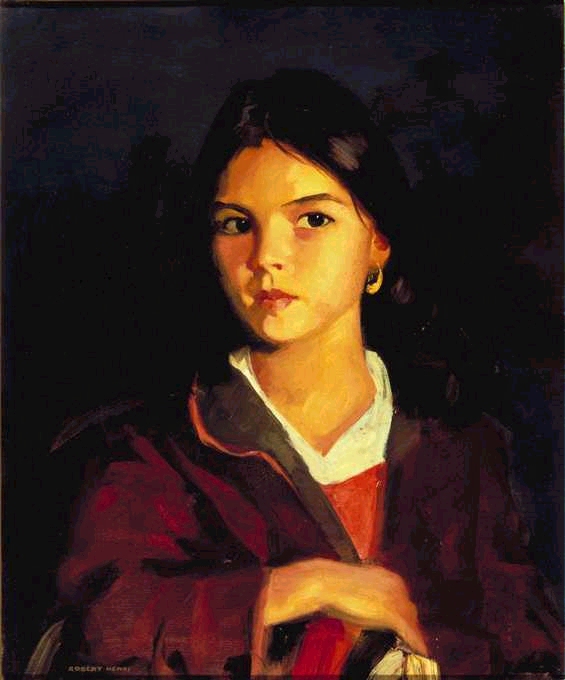
Philosophers have long said that we experience the world through our senses, and scientists have confirmed this.  The ability to see is one of our dominant senses.  The question that Robert Henri is raising here is about our memory of what we see.  Both painters and writers need strong visual memory in order to put detail into their work.  Painters often work from observing models, but they also need to be able to work from the memory of that model.  The same is true of writers.  We must be able to describe our characters, the setting and the physical world.  Often the physical world provides the reader with insight into the nature of a character.

Bernadita (1926)
Robert Henri
Visual memory is something I struggle with both as a writer and a reader.  When I come to a long descriptive passage in a novel, I will skim through it quickly so as not to be bored.  When I write, I struggle to put in visual detail of the person and his surroundings.  As a speaker I can be in a room for eight hours with a group of people, but at the end of the day I could not describe their faces or the clothes they were wearing.  

The only place where I have discovered that I have a strong visual memory is when I am driving.  I can have driven through a city once and come back five years later and I will remember visual elements and be able to find my way around without getting lost. Somehow subconsciously, my brain picks up the physical clues and I remember them when I am back in the same place, but if you were to ask me to describe the place I could not.

For the past fifteen years I have been cultivating my visual memory through the study of art. If your visual memory is weak like mine, I would encourage you to find ways to improve your visual literacy.  Most creative leaders need a strong visual memory.

Monday, April 11, 2016

Dr. Benjamin Mays — Goals


Research shows that only about 2% of Americans write goals.  I was 35 years old when I first heard about the importance of goal-setting in achieving one's dreams. In college I had dreamed of being a writer but at 35 was far from my dream. I had only written about 200 poems in 15 years. I set a goal to write a poem a day for a year. That year I wrote over 400 poems.

If you want to achieve your dreams, you need to turn them into goals.  Goals are dreams with deadlines.  Some creative leaders don't want to set goals because they are afraid they will not reach them. But the truth is that people achieve more when they have goals then when they don't. You may not reach the goal you set but you will come closer than if you had no goal. And as many people learn, the joy is in working to achieve the goal, not in actually achieving it. And when goal-setters reach their goal, they quickly set a new goal. 

I once met a 101 year old man who was writing his first book using a laptop computer in a nursing home. I visited that nursing home a couple of years later and the man, then 103, was writing his second book. What goals have you set for yourself? Your work? Your life?

Dr. Benjamin Mays must have been a master goal-setter for all that he accomplished. Mays was the youngest of eight children born to tenant farmers and former slaves in South Carolina. He earned a B.A. from Bates College in Maine, a Masters and a Ph.d in religion from the University of Chicago. He received almost 30 honorary doctorates in his lifetime. He was an ordained Baptist minister and an educator. He became President of Morehouse College in 1940, a post he held for 27 years. Mays wrote nearly 2,000 articles and nine books includingThe Negro's Church, the first sociological study of African-American religion. Dr. Martin Luther King, Jr., who graduated from Morehouse in 1948, called Mays his "spiritual mentor" and "intellectual father." 


Childhood home of Benjamin Mays

Monday, April 4, 2016

Louis Auchincloss — The Gift of Dreams


How often do we hold ourselves back from doing the things we want to do because we are afraid? Afraid of what others will say? Afraid of failure? Afraid of success? Afraid we don't have any talent?

Louis Auchincloss wrote this statement in his first memoir, A Writer's Capital, in 1974. In his 92 years on this planet, Auchincloss was a lawyer, a novelist, a short-story writer and a historian, publishing more than 60 books. He filled his life with things he wanted to do.
Dreams are creative gifts we have been given — paths that we should walk.  When we refuse to seek our dreams and refuse to do the work that needs to be done, we are rejecting the gift. We are denying our birthright. 

Is there something you have been dreaming of doing, but have not done it? Maybe today it is time to take that first step in achieving your dreams. If you don't, no one will care. Only you care about your dreams. Only you can achieve your dreams. Only you have the power it takes to achieve your dreams.

Today I celebrate my 67th birthday. I am thankful for the gifts I have been given — the dreams that I followed and the life I have lived.

Monday, March 28, 2016

Leonardo da Vinci — Miracle of Creativity


The ability to create is a miracle that has been given to the human race.  We have the ability to create something that did not exist previously.  From our early days in the caves to the high tech world of digital art, humans have had a need to share their stories and express their emotions.  Whether we sit around the campfire and mesmerize others with our stories or we sit in front of a computer and compose a novel, we are experiencing the miracle of creativity.

Some of us have tossed this miracle away by denying our ability to create.  Some of us have allowed others to destroy this miracle through their words and actions.  And some of us allowed our need for perfection to keep us from expressing ourselves.  The miracle of creativity is a gift that is sacred and we need to honor, respect and give thanks for what we have been given.

If you have lost the miracle of creation, you need to rediscover it.  You need to go deep within yourself and restore the miracle that is your birthright.  If the miracle of creativity has died a slow death within your soul, you need to resurrect it and celebrate the gift of life.

The miracle of creativity is the gift that gives the human race life.  Without creativity, there would be no progress — no growth.  Without creativity, we would not be human. Give thanks this week for the precious gift you have been given.  Celebrate the healing power of creativity.  Draw a picture.  Write a poem.  Tell a story.  Sing a song.

Monday, March 21, 2016

Natalie Goldberg — Listen Deeply


Most of us probably never associate the creative process with listening. We experience writing, painting and singing as active processes. We perceive listening to be a passive process. Actually, listening is very active and engaging. 

As writers and painters we need to be listening to the world around us and to the people within that world. By listening we learn to see the world for what it is. The better we understand our world the stronger artist we become. Those, who are so absorbed in themselves that that they do not listen, ultimately, will lose touch with the world and they will become weak.

Learn to listen with your heart, your body, your soul, your mind and your spirit. Taste the different flavors of the world around you. Explore the dark crevices and the deep roots. Climb the highest trees and tread on the sandiest beaches. Taste the heights of the human spirit and the deepest valleys of the human heart. Listen with every pore in your flesh. Listen with every cell in your body.

Here is Natalie Goldberg discussing the 30-year republication of her famous book, Writing Down the Bones


Monday, March 14, 2016

Milton Berle — Build a Door


Many times we have to make our own opportunities. People often complain that they were not given a chance. They fall into "If Only"thinking: "If only I could have gone to school." "If only my boss would have promoted me." "If only my parents loved me." "If only I had a job." "If only someone would publish my book." If only. . . . If only. . . . If only. . . . 

If you are going to achieve your dreams and accomplish your goals, you must move beyond "If Only" thinking to "Opportunity" thinking. You must build your own doors and knock on them.

What doors can you build today that you can knock on tomorrow? Building the door to opportunity does not just happen by accident. It takes hard work, belief in oneself and persistence.

Monday, March 7, 2016

Joan Miro — Planting Seeds of the Spirit


Growing up in a conservative Mennonite family, I was not exposed to art as a child. My maternal grandfather even forbid photographs and television.  My parents did not buy a TV until after he died. 

The Garden 2
Joan Miro
My first exposure to art came my freshman year in college where in one of my classes we had to choose an artist to study. I chose Joan Miro, a Spanish artist, and his paintings planted in my soul a love of art. I had an opportunity to study art history about 30 years later and fell in love with several painters including Diego Rivera, Frida Kahlo, Eastman Johnson, Edvard Munch and Pierre-Auguste Renoir. When you fall in love with a painting, you come back to it again and again for it to refresh your soul. 

A great novel stays with you long after you have read it. My all time favorite novel is Crime and Punishment by Fyodor Dostoyevsky.  I first read it college and have read it 3 times since.  

How many times do you listen to the same piece of music over and over. And each time you hear it years later, it brings back waves of emotion. Roberta Flack, Harry Chapin and Kris Kristofferson remain some of my favorite singers more than 40 years after I first heard them.  

Artists, musicians and writers all plant seeds with their works of art. What seeds are you planting with your writing, your painting or your music? How is your art impacting your audience? What seeds have you planted in their souls?


Monday, February 29, 2016

Christina Baldwin — The Gift of Creativity


Sometimes as writers we become caught up in the business of publishing and experience the hurt and pain of rejection. We become frustrated and sometimes quit writing because we don't think we are good enough. The need to write, to express ourselves, is not about being published. The need to write and to create is the gift in itself. Celebrate and honor the gift you have been given. Write for the sake of writing.  Write for the sake of the gift.

The same can be said of painting and any of the other forms of creative expression. Painting is not about selling your art to the highest bidder or having your painting hang in a museum somewhere. The art of painting is a gift to be honored and treasured. Respect and appreciate the gift that you have been given.


Monday, February 22, 2016

Gail Godwin — Writing Habits


Our minds are very powerful and capable of doing more than we imagine.  In a New York Times Book Review essay on the lives of aging writers, Gail Godwin told the reporter that she was able as she grew older to compose paragraphs in her mind and retain them — something she was unable to do in her youth.  She remembers as a young writer hearing Jorge Luis Borges tell his audience at the Iowa Writer's Workshop that blindness taught him to compose his stories in his head.  I know of poets who compose poems in their minds and are able to recite them from memory.

Many young writers and artists feel that if they are not successful by the time they turn forty, they have failed.  Yet, writing and painting is a learning process.  Creative power does not rest only with the young.  Some of us don't get our first wind until we are over sixty.  I remember reading the story many years ago of a writer who published his first novel in his thirties and his second in his eighties.

While Gail Godwin is best known for her fourteen novels, she has also composed music with Robert Starer and keeps colored pencils at her bedside.  On her website Godwin says that she will often draw before she goes to sleep.  She says: "I also draw when I am baffled by some aspect of the character.  Making a visual image of that character in action almost always reveals something new."

(Photo of Gail Godwin by David Hermon.)

Monday, February 15, 2016

Leo Buscaglia - The Healing Power of Hugs


After a speech a number of years ago, a manager came up to me and said she had a story to tell me about the healing power of hugs.

The manager, who was an administrator in health care, said that she had a long-term employee who began to come in late and even miss days of work. Being a good manager, she took note of this.

One day the manager saw the employee coming down the hallway. She said the employee seemed lost to the world — about ready to give up on life. Instinctively, the manager gave the woman a hug. The woman just stood there not knowing what to do or say. Every day after that the manager would give the woman a hug whenever she saw her.


After a couple of months the employee opened up and explained to the manager why she was so depressed. Her daughter had recently moved out of the home to attend college. Her son had moved out two years earlier and she was alone. And she said that it was the tenth anniversary of her husband’s death. She felt she had nothing left to live for.

For a while taking care of her patients kept her going. She knew her patients needed her so she would come to work. But she reached the point where her patients were not motivation enough. She decided to take her own life.

She came into work with the intention of gathering up her belongings and driving back home and taking her own life. That was the day the manager gave the woman her first hug. That hug saved her life and every hug after that helped to draw her out of a depression.

Hugging was not something I grew up doing. I was raised German Mennonite on a farm in central Illinois. As a family, we did not hug. My wife is of Mexican-American descent and she taught my family and me the importance of hugging. When I got into health care, nurses reinforced the importance of touch and hugging. So for the last 20 years of my parents’ lives I hugged them.

As writers and artists, we often work in isolation and yet we have this desire and need for human touch.  We should surround ourselves with supportive friends with whom we can cry  and who will give us a hug when we need it the most.  Healthy friendships are a necessary part of the creative process.

As creative leaders, we need to take care of our own emotional and mental heath so we have the strength to create more works of art.  Be sure to give your friends and family a hug each and every day.


Monday, February 8, 2016

Elizabeth Kubler-Ross


Silence is a valuable gift for writers and artists. Silence is where our work as creative leaders begins. We must go back to the well of silence again and again to refresh our spirit and restore our sanity. Silence allows us to process the tons of information that enter our brains. Silence allows creativity to take root and grow beautiful flowers. Silence allows for reason to prevail over ignorance.

There is a lot of noise in our society that clouds our thinking and hinders the flow of creativity. The noise of multiple voices rises from the traditional media: newspaper, radio and television. And the noise is multiplied a hundred times over today by the cell phones, the internet and social media. Each of these technologies has value and can contribute to our success, but we must manage and control their use, not let them control us. We must sometimes go silent and cut ourselves off from the noise. We must go deep inside and experience the silence.

And in the silence we will know and understand our purpose. If we lose sight of our purpose, we will lose our way and become lost in the noise and chaos. The silence allows us to find ourselves and to stay focused on what is important and why we are here.

Are you in touch with your purpose? Do you know why you are here? Do you know what lessons you have learned and what lessons you still need to learn? How are you going to make a positive contribution to the world at large? What are you giving back to society? Seek to know who you are by knowing your purpose for being. Embrace the silence and stay focused on your purpose.

Monday, February 1, 2016

Prakashan B.V.


Happiness does not come from buying a new house or an expensive car.  The thrill of buying something new is very short-lived. Happiness can not be found in the world outside ourselves.  Happiness is an inside job.  Each of us is responsible for our own happiness.

The same can be said for those of us who are creative leaders.  The happiness created by the acceptance of our work by a publisher or an art gallery is only temporary.  If we are not happy on the inside, we will soon return to our negative feelings of failure and frustration.

There is always going to be someone who is richer than you — more successful than you. Likewise, there is always someone who is poorer than you — less successful that you. No amount of money or success will free us from our fears and doubts.  No amount of money will eliminate the pain in our hearts. If you win the lottery tomorrow, you will still be the same person you are today.  The money will not make you happy if you are not already happy.

Happiness comes from loving and caring for those around us — from sharing of ourselves with the people in our lives. Happiness comes from creating what we want to create, not what the market wants to buy. Happiness comes from making the most with what you have and not coveting the success of your neighbor.

Monday, January 25, 2016

Diego Rivera


"Only the work of art itself 
can raise the standard of taste."

— Diego Rivera
Mexican Artist / Muralist
1886 - 1957

The Flower Carrier
People talk of taste as if it was real.  It is an illusion of judgement.  Every work of art, every poem, and every story has value.  When people begin to label art as good or bad, they are creating false categories that are based on artificial judgements.  What the majority label as good today may be considered bad tomorrow.  You may like something or not like something which in itself is okay.  Liking or disliking reveals something about you.  There is nothing inherently bad or good within the work of art itself.  The sense of good or bad is in the eyes of the beholder. Any judgement made about a work of art is actually a judgement of the person who made the statement.

While there may only be one person today who likes your art, it does not make the art bad. Two hundred years from now the majority of people may consider it a masterpiece.  Taste is fickle and useless.

Diego Rivera, the great Mexican Muralist,  painted a number of murals in the United States during the 1930's.  Edsel Ford hired him to paint a mural at the Detroit Institute of Arts which is still on view today.  John Rockefeller commissioned him to paint a mural in New York.  Since Rivera was a communist, he included a portrait of Lenin in the mural.  When Rockefeller demanded that he remove the portrait from the mural, Rivera refused.  Rockefeller had the mural destroyed.  In the 1930's, a portrait of Lenin was unacceptable to the American public taste.  A work of art was destroyed because the subject matter was unacceptable.  Three hundred years from now, most people probably will never had heard of Lenin and nobody will be offended.  Remember public taste is fickle and arbitrary.


Monday, January 18, 2016

Martin Luther King Jr.


Dr. Martin Luther King Jr.

"If a man is called to be a street sweeper, he should sweep streets even as Michelangelo painted, or Beethoven composed music or Shakespeare wrote poetry.  He should sweep streets so well that all the hosts of heaven and earth will pause to say, 'Here lived a great street sweeper who did his job well.'"


American Civil Rights Leader/Preacher/Author
1929 - 1968


Dr. Martin Luther King Jr.
One of those games we play is:  "Where were you when . . ."  On April 4, 1968, I was a nineteen year old college student at Goshen College in Indiana.  Two months earlier I had the privilege of marching with Dr. King at a Vietnam War protest march in Washington D.C. The murder of Dr. King on my birthday in 1968 impacted me both emotionally and spiritually.

For the past twenty-five years I have been sharing this quote by Dr. King in my speeches on leadership.  I believe that work is spiritual in nature.  The work we do helps to cleanse our souls and free our spirits.  Many people see work as a negative condition.  They hate Mondays and grumble about having to go to work.  Many people wish they did not have to work.  But if you have ever lost a job and sat idle for a few months, you appreciate the value of work in your life.

As creative leaders we have a special opportunity to share the fruit of our labor with others. Most of my life I have dreamed of being able to give up my bill-paying job and write full time.  Fortunately, this never happened.  I think I am a better person for having the discipline to get up an hour earlier than everyone and writing before going to work.  Sometimes what we wish for is not in our best interests.  The bill-paying work and the creative work are both important and both have helped to make me a better person.

Be proud of the work you do.  Celebrate the work you do.  Be happy with the gifts you have been given.