Welcome!

Welcome! There are more than 900 Inspirational Quotes For Writers, Artists and Other Creative Leaders on this site.
Spend a few minutes exploring. And come back again and again for other inspirational quotes.

Monday, April 18, 2011

Sidney Nolan

"Painting is an extension of man's means of communication.  As such, it's pure, difficult, and wonderful."


Australian Artist
1917 - 1992


All the arts are about communication.  Whether you paint, write, sing or act, you are involved in the process of communicating.  And communication is one of the most difficult aspects of being human.  We never seem to get it right.  Marriages break up over the inability to communicate.  Children don't speak to their parents.  Bosses fail to inspire their employees.

Painting, poetry and novels are highly specialized forms of communication — an attempt by the artist to tell the world what he is feeling.  And sometimes he is successful and sometimes he is not.  Take this painting, Death of Sergeant Kennedy at Stringbark Creek, by Sidney Nolan.  What does it communicate to you?  If I asked 10 different people the same question, I bet I would get 10 different answers.  Communication is very difficult.  If it was easy, we probably would not have a need for creative leaders who work hard at communicating.


Even artists and writers don't always know what they are communicating with their creative work.  Paintings, poetry and novels are often communicating on multiple levels with multiple messages.  The painter, poet and novelist are aware of some of these messages but not all of them.  That is what makes art so fascinating.


If you are interested in feedback from your audience, don't ask whether they liked the work or if it was any good.  Ask: "What does my painting, poem or story communicate to you?"  Then listen with your heart and soul.  You may be amazed at what others see in your work.

Sunday, April 17, 2011

Edgar Degas

Self-Portrait
(1855)
"Only when he no longer knows what he is doing does the painter do good things."


French Artist
1834 - 1917


Dancers
(1978)
Have you ever become so lost in your creativity that you don't know what you are doing?  I sometimes become so caught up in the writing of the moment that I don't realize what I am saying.  I read my writing a day or two later and am surprised by what I said.  The more I can quiet the conscious mind and let the subconscious mind take charge, the more creative the writing becomes.  

The difference between the conscious mind and subconscious mind is one of control.  The subconscious is more wild, free and metaphoric.  The conscious mind is more analytical, linear and controlling.  Creativity requires entering the subconscious and exploring the world through its eyes.  The more we try to control our art the less creative and original it becomes.  The more we relinquish control, the stronger the creative impulse.

Saturday, April 16, 2011

Ernest Hemingway

"We are all apprentices in a craft where no one ever becomes a master."


— Ernest Hemingway
American Novelist
1899 - 1961


This is an amazing statement from a writer whom many would call a master.  I think what Hemingway is saying is that we should never stop learning about our craft.  Even the best of the best can learn something new — can improve their craft.  The task of becoming good never ends.  We are all apprentices — beginners.  We must come to the task of creating each work of art as a beginner would.

Those who believe there is nothing left to learn have stopped growing and will soon be spiritually dead and doomed to a life of repetition.  Life is in the learning.  Life is in the growing.  So don't despair if you don't know everything because you never will.  Don't despair if you haven't perfected your craft.  The joy is in the learning.  The joy is in the discovery of ways to improve your craft.

Friday, April 15, 2011

Rita Dove

"Poetry is language at its most distilled and most powerful."


American Poet
1952 - 


If you stripped your art down to the bare bones, what would be left?  A line? A word?  An emotion?  If you look at the history of the arts, you will notice that artists vacillate between extravagance and simplicity, between embellishment and bare bones.  My style has been one of simple speech, with few big words or large flourishes.  If you distilled your art down to its essence, what would you find?  What is at the core of your art?

April is poetry month.  Here is a poem by Rita Dove.


"Teach Us To Number Our Days"

In  the old neighborhood, each funeral parlor
is more elaborate than the last.
The alleys smell of cops, pistols bumping their thighs,
each chamber steeled with a slim blue bullet.

Low-rent balconies stacked to the sky.
A boy plays tic-tac-toe on a moon
crossed by TV antennae, dreams

he has swallowed a blue bean.
It takes root in his gut, sprouts
and twines upward, the vines curling
around the sockets and locking them shut.

And this sky, knotting like a dark tie?
The patroller, disinterested, holds all the beans.

August.  The mums nod past, each prickly heart on a sleeve.


(By Rita Dove from Yellow House on the Corner, Carnegie Mellon University Press, 1989)

Here is Rita Dove reading another of her poems.


Thursday, April 14, 2011

Charles Baudelaire

"Any healthy man can go without food for two days — but not poetry."


French Poet
1821 - 1867


Obviously, Baudelaire was passionate about poetry.  Are you passionate about your creative work?  Are you able to live without producing a poem, a play or a painting?  While my goal is to write every day, there are some days I don't have the time.  If I don't write for several days, I can feel my need to write growing within my spirit.  I have to sit down and put pen to paper.

There are three levels of involvement that people have with their art.  These levels are best illustrated by the three key players in breakfast.  The first level is illustrated by the farmer.  He is hungry and wants something to eat.  He is interested in the breakfast.  The hen illustrates the second level.  She is committed to the breakfast.  She is willing to share her eggs with the farmer.  The pig illustrates the third level.  He is passionate about the breakfast because he is willing to put his bacon on the line.  Are you just interested in your art much like the farmer?  Or are you committed to your art like the hen?  Or are you passionate about your art like the pig?  Are you willing to put your bacon on line for your art?


Wednesday, April 13, 2011

Walt Whitman

"To have great poets there must be great audiences too."


American Poet
1819 - 1892


I have been listening to a biography of the singer, Marvin Gaye, and one of the emotional struggles he faced was whether to write and produce the kind of songs that he wanted to and his muse demanded or to write songs for his audience.  Gaye apparently vacilated back and forth.  He felt guilty when he pandered to his audience and the money they gave him.  He felt he was betraying his musical vision.  Every artist, writer, actor and singer has experienced similar frustrations.  We want our work to be accepted by the public, but we don't want them to dictate what we create.  It is a fine balancing act.

Every artistic work requires an audience whether it is an audience of one or a thousand.  The great artists, writers, poets are fortunate to find great audiences, even though it may be after they die.  And sometimes great audiences will push the artists to create even greater works.  Actors and musicians will tell you that live audiences impact their performances positively and negatively.

Who do you create for?  Yourself?  Or your audience?  Are you frustrated by having to create what people want to buy?  How do you balance the demands of your muse and the expectations of your audience?

Tuesday, April 12, 2011

Richard Wollheim

"Learning appears as a way of staying young, perhaps of staying alive, and also as a way of growing up, perhaps facing death."


British Author, Philosopher
1923 - 2003


Life-long learning is a powerful habit to develop.  Learning something new keeps us in touch with our youth and helps us to stay active and alive.  What have you learned in the last week?  Who has taught you something new about yourself or your art?  

We experience the world through our senses — hearing, seeing, tasting, touching and smelling.  And what we experience teaches us much if we are paying attention and alert to the possibilities.  Did you smell the wind today?  Did you hear the approaching storm?  Do you taste the rain on your face?

From the time we are born until we die, our purpose is to learn, to grow, and to change.  Most learning does not occur in school and we don't stop learning once we graduate.  Cultivate a learning attitude.  Unfortunately, many people do not learn from their mistakes.  They are not willing to change and grow.  To be a great artist or writer, you must be constantly learning about the world in which we inhabit.

And when we face death, it will teach us much that we have forgotten.  Do not be afraid of death.  Understand that it is a gift.  It is a door through which we pass, a gate that leads to another world.

Monday, April 11, 2011

The Power of Words

Do you believe in the power of words to change people?  Watch this.


Paula Rego

"To find one's way anywhere one has to find one's door, just like Alice, you see.  You take too much of one thing and you get too big, then you take too much of another and you get too small.  You've got to find your own doorway into things."


Portuguese Artist
1935 -


The doors we open and the doors we close hold the keys to our success.  What doors have you failed to open that would catapult you miles down the road?  What doors if you learned to shut them and throw away the key would prevent others from zapping your energy?


The door is an amazing invention.  It keeps out those people we don't want in our lives yet allows us to choose who can enter and keep us company.  The door serves a similar function for creative leaders.  We can keep out those elements of our lives that we don't want to appear in our art and we can invite in what we want to appear in our art.


The Family
(1988)
To paraphrase the poet, Robert Frost, doors make good families.  Doors give us privacy and keep prying eyes from seeing what we don't want them to see.  Some doors are simple and others are complex.  Some doors have intricate designs and others are plain.  Doors help us to manage and control our lives.  Doors help us to hide things we don't want people to see and to reveal things we want people to see.


Can you identify the doors in your life?  Do these doors help you be more creative or do they restrict your creativity?  Do you need to replace some of the doors in your life?  Do you need to add doors to your life?


Here is a video with more of Paula Rego's paintings.


Sunday, April 10, 2011

Maria Luz Q. King

Dancer
(2007)
"I have learned that in life nothing is forever, so maybe our dreams are not meant to be forever.  But the memory is forever!  The memories are what we take to heaven."


Mexican-American Artist, Author
1952 - 


Homeless
(2007)
Have you ever let go of your dreams?  I don't mean quit on your dreams.  I don't mean give up on your dreams.  I mean let them go.  Maybe you have outgrown them.  Or maybe you achieved the dream for a short period of time and that was enough.  Maybe our dreams are not meant to be forever.  Nothing in this physical world is permanent.  Nothing lasts forever.  The seasons come and go.  And so do people.  

Are there dreams that you need to let go of?  Are there dreams that are holding you back from success?  Sometimes our fantasies and dreams become barriers that prevent us from becoming whom we need to become.  Are you clinging to some dream that will never happen?  Is it time to let the dream go?

Where do our dreams come from?  Our genes?  Our parents?  Society?  God?  Do we take our dreams with us when we die?  Or do our dreams die with our bodies?  I think our dreams are gifts that provide meaning to our lives.  Our dreams inspire us to do more — to achieve more, to be more.

Saturday, April 9, 2011

Denis Waitley

"Failure should be our teacher, not our undertaker.  Failure is delay, not defeat.  It is a temporary detour, not a dead end."


American Author, Speaker
1933 -


How do you view failure?  When you feel you have failed at something, do you stop doing it?  Failure for many people is a dead end.  They don't view it as a detour on the road of life.  How you respond to perceived failure says a lot about who you are and what you will accomplish in life.  

Every failure is an opportunity to learn something new?  To increase our understanding of the world around us.  What have you learned from your failures?  Do you use your failures as inspiration to work harder?  Or do your failures become your excuse to quit and give up?  Failure is a test of your character and your determination.

Playing sports taught me a lot about failure.  In baseball, no batter gets a hit every time he comes up to bat.  In fact, if a batter gets a hit three out of ten at bats, he is considered to be an great hitter.  In Little League, I was not a very good hitter despite my size.  My best game was two weeks after appendix surgery.  I played three innings and had 2 singles.

In basketball, no player makes every shot he takes.  In fact, if a player makes 50% of his shots, he is considered to be a good shooter.  When I was a freshman in high school, I dreamed of playing in and winning the state high school championship my senior year.  And while my team had a record of 28 wins and 1 loss, we never made it to the state championship.  That final loss and failure to play in the championship became a symbol for my loss of religious faith.  And for years I held onto that symbol and let it guide my life.  What I saw as a failure was actually a very successful year.  To play 29 games and only to lose the last one is a fantastic record.  Many teams would love to have that kind of winning record.  But in my mind's eye I saw it as a failure.

What failures are you holding onto?  What failures do you need to let go?


Friday, April 8, 2011

Rita Coolidge

"Too often the opportunity knocks, but by the time you disengage the chain, push back the bolt, unhook the two locks and shut off the burglar alarms, it's too late."


American Musician
1945 - 


Has opportunity passed you by?  Are you so busy protecting yourself from the world that you have missed opportunities when they came calling?  Opportunity often requires that we move fast.  If we hesitate, we lose.  And sometimes we miss opportunities because we are waiting for the perfect opportunity to appear.  No opportunities are perfect.  They are all filled with risk.  And sometimes opportunity leads to failure.  But the bigger failure is to not to have tried at all.  And when we are open to opportunity knocking, we will be surprised by how one opportunity will open up other opportunities.  So get off your couch and open the door.  Opportunity is visiting and he doesn't like to be ignored.

Here is Rita Coolidge singing Superstar.  Enjoy as you contemplate your opportunities.


Thursday, April 7, 2011

James Galvin

"Let us begin with a simple line,
Drawn as a child would draw it,
To indicate the horizon...."


American Poet
1951 -


In drawing and writing, we almost always begin with the line.  The line turns into letters which turn into words which turn into sentences.  And eventually the sentences become poems, short stories and novels.  The same is often true is art.  The line becomes an eye, then a nose and soon a face.  The drawing begins as a simple line much like what a child starts with.  The artist then transforms that line into a beautiful portrait, landscape or abstract painting.

When we begin the canvas and the paper are blank, empty, without much meaning.  As creative artists our job is transform that paper or that canvas into more.  To create something out of a simple line.  To communicate our vision of the world through a simple line joined with other simple lines — one built on another.

The same can be said about life.  Each moment we live is like a simple line.  We build a life through living each moment to the fullest.  And millions of moments become a life lived.  

Here is the poem, Art Class, by James Galvin.


Art Class
By James Galvin

Let us begin with a simple line,
Drawn as a child would draw it,
To indicate the horizon,

More real than the real horizon,
Which is less than line,
Which is a visible abstraction, a ratio.

The line ravishes the page with implications
Of white earth, white sky!

The horizon moves as we move,
Making us feel central.
But the horizon is an empty shell —

Strange radius whose center is peripheral.
As the horizon draws us on, withdrawing,
The line draws us in,

Requiring further lines,
Engendering curves, verticals, diagonals,
Urging shades, shapes, figures...

What should we place, in all good faith,
On the horizon? A stone?
An empty chair? A submarine?

Take your time.  Take it easy.
The horizon will not stop abstracting us.

Wednesday, April 6, 2011

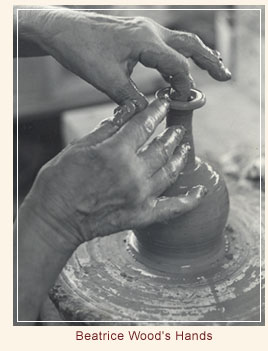
Beatrice Wood

Photo by
William Gray Harris
"Very few people know how to work.  Inspiration, everyone has inspiration, that's just hot air."


American Potter, Artist
1893 - 1998


I have often heard beginning writers say that they only write when they are inspired.  Unfortunately, if they wait until they are inspired, their output will be very small.  Most experienced artists and writers know they must work whether they are inspired or not.  Often when we work the inspiration will arrive on its own time and when we least expect it.  

Success comes from work.  Work when you are sad.  Work when you are happy.  Work when you don't feel like it.  Work when you want to go to a movie.  Our minds are very good at finding excuses for not working.  "I have to do the dishes."  "I have to wash the clothes."  And the list goes on.  Work takes discipline and will power.  

See writing and painting as a job that you need to show up to every day.  Since you have no boss but yourself, you have to hold yourself accountable.  Schedule your hours when you are most creative and stick to your schedule.  Maybe you write between 5 am and 6 am.  Or if you have the luxury, schedule your work hours from 8 am to 5 pm with an hour off for lunch.  Some writers write in the morning and do their research and marketing in the afternoon.  You have to find the schedule that best fits your temperament.

Tuesday, April 5, 2011

Oskar Kokoschka

"How do I define a work of art?  It is not an asset in the stock-exchange sense, but a man's timid attempt to repeat the miracle that the simplest peasant girl is capable of at any time, that of magically producing life out of nothing."


Austrian Painter, Poet, Playwright
1886 - 1980


The Bride of the Wind
(1914)
When I stop and think about it, the birth of a child is probably one of the greatest miracles known to the human race.  Although I must say that it takes more than a simple peasant girl.  A peasant boy is usually involved also.  Nothing we do as painters, writers or composers will ever equal the conception of a child.  But that should not discourage us.  What we create is our attempt at defeating death — to live beyond the few short years we are given.  And for some they work will survive hundreds of years.

How do you define the artistic work that you do?  Why do you do it?  What motivates you to create new pieces of work?  Where do you place creative work in the greater scheme of things?

Here is a video that displays some of the paintings of Oskar Kokoschka.  Enjoy.


Monday, April 4, 2011

Harley King

Self-Portrait
Oil Pastels
(2011)
"Sometimes we fight who we are, struggling against ourselves and our natures.  But we must learn to accept who we are and appreciate who we become.  We must love ourselves for what and who we are, and believe in our talents."


American Poet, Speaker
1949 - 


I have struggled much of my life to find myself and my place in this world.  I have never been satisfied, always wanting to do more, to accomplish more.  I wanted to be a famous writer.  But instead, my success came through my speaking.  While I have published 14 books, my readership is small and my paycheck is even smaller.  Yet, somewhere a long the way I learned to accept who I am and to trust that I am doing what I am supposed to be doing.  I touch people's lives with my words.  

I wrote the words above when I turned fifty.  Today I turn 62 and I feel that I have learned not to struggle against myself, and have accepted who I am as well as my strengths and limitations.  I have learned to hug myself and to love who I am.

Have you learned to love yourself and to believe in your talents?  Do you appreciate the life you live and accept your strengths and weaknesses?  None of us are perfect and the lives we lead are not perfect, but we are leading the life we have chosen through our thoughts and actions.  


Here is a link to my reading of my poem, Indecision, inspired by the Renoir painting, Umbrellas.  Click on Indecision and it will take you to a page on my website.

Sunday, April 3, 2011

Maurice Chevalier

"A man must have his dreams — memory dreams of the past and eager dreams of the future.  I never want to stop reaching for new goals."


French Actor, Singer
1888 - 1972


What does your future hold for you?  Have you ever wished you knew the answer to that question?  How would change your life if you could predict the future?  Do you read your horoscope regularly?  Do you wish you had a crystal ball into which you could gaze?

I do believe that we often know what is going to happen to us before it actually happens.  Years ago I kept a dream journal where I recorded a dream of marrying my wife a month before I met her.  I am convinced that some of our nighttime dreams can predict the future.  Learn to listen to your subconscious.

But I am also convinced that we can predict our future by setting goals.  Goals give a focus and a direction to our lives.  Our lives are like a journey.  If we have a road map, we are more likely to reach our destination, to achieve our dreams.  Goals serve as the road map.  But like any trip, there can be detours, flat tires and accidents.  The road map is not the journey, only a guide.  And sometimes it is the side trips that are more interesting than the interstate.  And the people we meet along the way will touch our lives and teach us much.

So what is the road map for your life?  Where are you headed?  Are you on a side road or the main highway?  Are you hitchhiking through life or are you driving a Corvette?  Who is sitting in the seat next to you?  Who is in the backseat?  When you reach the end of the road one day (and we all will reach the end of the road), what is the legacy you will leave behind?  Will you have achieved your goals?  Will you have produced the art you dreamed of creating?  How will you remember your life?

Here is a video of Maurice Chevalier with Hermione Gingold singing, "I Remember It Well."  Enjoy.


Saturday, April 2, 2011

Flannery O'Connor

"Anybody who has survived his childhood has enough information about life to last him the rest of his days."


American Novelist
1925 - 1964


Do you remember your childhood?  Some people block out memories of their childhood?  Others have a difficult time forgetting even the most painful memories.  As artists and writers we can mine our past experiences for inspiration for our art.  What events out of your childhood can you use in your stories or your art?  Remember art should transform the actual events into more than just the mere facts like spinning straw into gold.


Here are links to three story poems where I transformed childhood stories and events into more than family history — where I discovered a truth greater than facts.


Mary Lou
http://web.mac.com/hgking/HarleyKing/Mary_Lou.html

Sister
http://web.mac.com/hgking/HarleyKing/Sister.html


Brother Al
http://web.mac.com/hgking/HarleyKing/Brother_Al.html

Friday, April 1, 2011

Salman Rushdie

"Those who do not have power over the story that dominates their lives, power to retell it, rethink it, deconstruct it, joke about it, and change it as times change, truly are powerless, because they cannot think new thoughts."


Indian Novelist
1947 - 


Are you revisiting the stories that you tell about your life?  Are you able to change the stories that you tell about your life?  Are you able to think new thoughts about your talents and your capabilities?

We all face challenges in life -- challenges that impact the physical, mental, emotional and spiritual aspects of our lives.  How we tell the story either gives us power over the events or makes us powerless.

In 2006 I was diagnosed with prostate cancer and had robotic surgery.  I chose not to be a cancer victim.  Within a month of the diagnosis, I decided that the cancer was a gift that would open up new worlds and give me opportunities to meet new people.  I do not see myself as a cancer survivor.  I am very lucky to have received such a gift for what it has taught me.  I am a life-long learner and the cancer was just another experience in my life.

What challenges in your life do you need to reframe -- to retell?  We are all here to learn lessons.  What lessons are you learning from the challenges you face.  How are you retelling your stories to give you more power over the challenges?