Welcome!

Welcome! There are more than 900 Inspirational Quotes For Writers, Artists and Other Creative Leaders on this site.
Spend a few minutes exploring. And come back again and again for other inspirational quotes.

Tuesday, January 18, 2011

Franklin D. Roosevelt

"Happiness lies in the joy of achievement and the thrill of creative effort."


— Franklin D. Roosevelt
32nd President of the United States
1882 - 1945


Creativity is not limited to writers, artists and musicians.  Anyone can be creative if they open themselves up and listen to the ideas inside.  Who has not had a better idea about something?  There are creative business people who have new ideas about how to do something better.  There are creative doctors who develop better ways to treat patients.  My dentist has developed 12 products that he has sold on the market. Unfortunately, some people bury their creativity deep inside.  They even announce loudly to those around them: "I don't have a creative bone in my body."  We all have the potential to be creative if we allow ourselves the opportunity.

Creativity is one of the most thrilling acts that we as humans can participate in.  If you have ever experienced the excitement of chasing a new idea or exploring a new way of seeing the world you will understand what Roosevelt is saying.  Some people might say that Roosevelt was not creative.  He did not produce any great works of art.  His creativity lay in his ability to change the way he and others saw the world.  The ideas that rose to the surface during his Presidency dramatically changed life in the United States and around the world.  People today are still trying to understand the impact of changes Roosevelt created in our society and our politics.  Roosevelt was a creative leader.

I have come to believe that one of the blessings in disguise in my life was the rejection of religion at young age.  It released a tidal wave of creativity within me.  It freed me to question any idea.  Otherwise, I think, today I would find myself in a straitjacket of rules and regulations.  As a child I was obsessed with the Bible.  I would have an anxiety attack if anything was placed on top of the Bible.  I had to remove it immediately.  If I had continued down that path, it would have led to some form of insanity.

What are you doing to cultivate creativity in your life?  Give yourself the freedom to look at the world in new ways.  See the world in ways that others don't.  Don't accept things as they are.  Question why?  Creativity is not about technique.  It is about seeing the world in new ways.  

Monday, January 17, 2011

Ivan Albright

Self-Portrait
Ivan Albright
(1981)
"A painting is life and a painting is death . . . the picture is our own legacy left by tomorrow's dead for tomorrow's living."


American Artist
1897 - 1983


The Picture of Dorian Gray
Ivan Albright
(1943)
What will your legacy be?  What is your reason for being?  Why are you here?  We will all reach the end of the road one day.  What will you be remembered for?  As creative leaders we have an opportunity to leave the legacy of our work — our paintings, our poems, our songs and our stories.  And for some of us, we may be remembered for years and even centuries, but most of us will be forgotten except by those who loved us.  And for me, the most important legacy is the lives we have touched, the people we have met and the people we have loved.  Don't get me wrong.  Our creative work is very important, but the people in our lives are even more important.  Unfortunately, some of us sacrifice one for the other.  We need to learn balance.  To give to each what is needed.  What will your legacy be?

Sunday, January 16, 2011

Douglas Adams

"I may not have gone where I intended to go, but I think I have ended up where I needed to be."


1952 - 2001
English novelist


When we are young, we have lots of dreams of what we want to do with our lives.  When I was in junior high, I wanted to be an architect.  My father was a general contractor and build over 300 houses in his lifetime so I am sure that was an influence on my dream.  But in recent years, I realize that I had as a child a desire to draw which no one encouraged.  When I was a sophomore in high school I made a commitment to be a minister.  By the time I was a senior in high school I had lost my faith in religion.  In college I dreamed of being a writer.  My life may not have turned out as I imagined, but I believe it turned out better and I became what I was meant to be.

I have spent more than 35 years writing poetry and short stories.  I have published 14 books and hundreds of poems.  I have spent over 20 years as a motivational speaker (ministry) touching people's hearts and souls.  And late in my life I have turned to painting masks.  I know I ended up where I needed to be and did what I needed to do.

I believe that we are all here on this earth to learn lessons and grow.  Everything that happens to us will teach us valuable lessons.  The choices we make will lead us down the roads we need to travel.  We will arrive where we are meant to be, having learned the lessons we were meant to learn.

When I was 50 I wrote an article, "What do I want to be when I grow up? Or how I found myself!", that appeared in my college alumni magazine.  In the article I describe how became what I was meant to be.

Saturday, January 15, 2011

Bernie Siegel

"In the face of uncertainty, there is nothing wrong with hope."


American Author / Physician


As a young writer hope is one of the few things that kept me going.  I would read a story about someone who was 50 or 60 or 7o and he had just published his first novel.  After years of toiling in the salt mines of writing, he found success.  These stories inspired me to keep writing.  I had hope that one day I would be discovered and become successful.  Even today I have that sense of hope, that belief that one day I will be proved right.  Yes, I am a writer.

When we lose hope, we give up on life.  We quit.  Some days all we have is hope.  As the old saying goes: every dark cloud as a silver lining.  We just have to find it — to look at the world with new eyes.  No matter how dark the night, there is always a sunrise.  Everyone faces challenges and difficulties.  The sad thing for me is people who see no way out of a problem but to take their own lives.  Never give up hope for a better tomorrow.

As creative thinkers, we need hope.  We need to believe in ourselves, our ideas, our art.  Have faith that you have been given a gift.  Have faith in your dreams.  Have faith that the sun will rise again.


Friday, January 14, 2011

Robert Henri

"Develop your visual memory.  Draw everything you have drawn from the model from memory as well."


American Artist
1865 - 1929


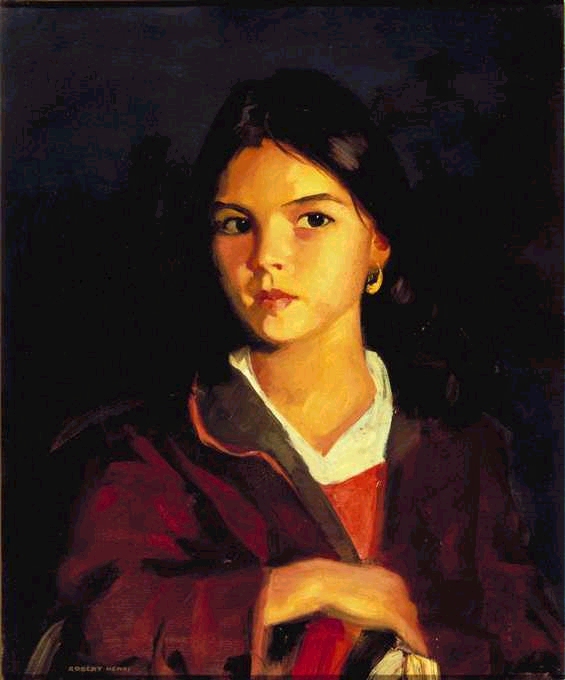
Philosophers have long said that we experience the world through our senses.  The ability to see is one of our dominant senses.  The question that Henri is raising here is about our memory of what we see.  Both painters and writers need strong visual memory in order to put detail into their work.  Painters often work from observing models, but they also need to be able to work from the memory of that model.  The same is true of writers.  We must be able to describe our characters, the setting and the physical world.  Often the physical world tells the reader more about the nature of a person.

Bernadita (1926)
Visual memory is something I struggle with both as a writer and a reader.  When I come to a long descriptive passage in a novel, I will skim through it quickly so as not to be bored.  When I write I struggle to put in visual detail of the person and his surroundings.  As a speaker I can be in a room for eight hours with a group of people, but at the end of the day I could not describe the clothes they were wearing.  The only place where I have discovered that I have a strong visual memory is when I am driving.  I can have driven through a city once and come back five years later and I will remember visual elements and be able to find my way around without getting lost.  Somehow subconsciously, my brain picks up the physical clues and I remember them when I am back in the same place, but if you asked me to describe the place I could not.

For the past ten years I have been cultivating my visual memory through the study of art.  If your visual memory is weak like mine, I would encourage you to find ways to improve your visual skills.  Most creative leaders need a strong visual memory.

Thursday, January 13, 2011

Benjamin Mays

"The tragedy of life doesn't lie in not reaching your goal.  The tragedy lies in having no goal to reach."


Dr. Benjamin Mays
American Author / Educator / Minister
1894 - 1984


Some creative leaders don't want to set goals because they are afraid they will not reach them.  But the truth is that people achieve more when they have goals then when they don't.  You may not reach the goal you set but you will come closer than if you had no goal.  And as many people learn, the joy is in working to achieve the goal, not in actually achieving it.  And when goal-setters reach their goal, they quickly set a new goal.  

I once met a 101 year old man who was writing his first book using a laptop computer in a nursing home.  I visited that nursing home a couple of years later and the man, then 103, was writing his second book.  What goals have you set for yourself?  Your work?  Your life?

Childhood home
of Benjamin Mays
Dr. Benjamin Mays must have been a master goal-setter for all that he accomplished.  Mays was the youngest of eight children born to tenant farmers and former slaves in South Carolina.  He earned a B.A. from Bates College in Maine, a Masters and a Ph.d in religion from the University of Chicago.  He received almost 30 honorary doctorates in his lifetime.  He was an ordained Baptist minister and an educator.  He became President of Morehouse College in 1940, a post he held for 27 years.  Mays wrote nearly 2,000 articles and nine books including The Negro's Church, the first sociological study of African-American religion.  Dr. Martin Luther King, Jr., who graduated from Morehouse in 1948, called Mays his "spiritual mentor" and "intellectual father."

Wednesday, January 12, 2011

Pierre Auguste Renoir

Self-Portrait, 1910
"There are some things in painting which cannot be explained, and that something is essential."


French Artist
1841 - 1919


On the Terrace, 1881


All art (painting, sculpture, literature, music, etc) has something that cannot be explained, identified or understood.  A work of art is greater than its creator.  A work of art is greater than the sum of its parts.  When you look at a painting what do you see?  What do you not see?  What is the soul of the painting?  When you read a story what do you feel?  What do you not feel?  What is the heart of the story?  When you listen to music what do you hear?  What do you not hear?  What is the spirit of the music?

When I write a poem, I don't always understand it and others may understand it even less.  The poem has a life of its own — a meaning of its own.  I will come upon it weeks, months and even years later and it has been transformed into something I do not know.  Some days I like it and some I don't, but it is beyond my control.  It laughs at me and demands that I leave it alone.  It never thanks me for bringing it into existence.  It accuses me of locking it in a closet.  It says I was a terrible parent.

Tuesday, January 11, 2011

Louis Auchincloss

"A man can spend his whole existence never learning the simple lesson that he has only one life and that if he fails to do what he wants with it, nobody really cares."


Louis Auchincloss
American Novelist / Lawyer
1917 - 2010


How often do we hold ourselves back from doing the things we want to do because we are afraid?  Afraid of what others will say?  Afraid of failure?  Afraid of success?  Louis Auchincloss wrote this statement in his first memoir, A Writer's Capital, in 1974.  In his 92 years on this planet, Auchincloss was a lawyer, a novelist, a short-story writer and a historian, publishing more than 60 books.  He filled his life with things he wanted to do.

Is there something you have been dreaming of doing, but have not done it?  Maybe today it is time to take that first step in achieving your dreams because if you don't no one else will care.  Only you care about your dreams.  Only you can achieve your dreams.

Monday, January 10, 2011

Natalie Goldberg

"Writing, too, is ninety percent listening.  You listen so deeply to the space around you that it fills you, and when you write, it pours out of you. . . . The deeper you listen, the better you can write."


American Writer
1948 - 


Most of us probably never associate writing or painting with listening.  Writing and painting are active processes.  We perceive listening to be a passive process.  Actually, listening is very active and engaging.  As writers and painters we need to be listening to the world around us. By listening we learn to see the world for what it is.  The better we understand our world the stronger artist we become.  Those, who are so absorbed in themselves that that they do not listen, ultimately, will lose touch with the world and they will become weak.

Learn to listen with your heart, your body, your soul, your mind and your spirit.  Taste the different flavors of the world around you.  Explore the dark crevices and the deep roots.  Climb the highest trees and tread on the sandiest beaches.  Taste the heights of the human spirit and the deepest valleys of the human heart.  Listen with every pore in your flesh.  Listen with every cell in your body.


Sunday, January 9, 2011

Milton Berle

"If opportunity doesn't knock, build a door."


American Comedian & Actor
1908 - 2002


Many times we have to make our own opportunities.  People often complain that they were not given a chance.  They fall into "If Only" thinking: "If only I could have gone to school."  "If only my boss would have promoted me."  "If only my parents loved me."  If only. . . . If only. . . .  If only. . . .  If you are going to achieve your dreams and accomplish your goals, you must move beyond "If Only" thinking to "Opportunity" thinking.  You must build your own doors and knock on them.

What doors can you build today that you can knock on tomorrow?  Building the door to opportunity does not just happen by accident.  It takes hard work, belief in oneself and persistence.

Saturday, January 8, 2011

Alfred Stieglitz

"All art, like all love, is rooted in heartache."


American Photographer
1864 - 1946


Photograph of
Georgia O'Keeffe
Pain, suffering and loneliness draw out the artist in each of us.  When we are suffering, we have a need to share our hurt with others.  Some of the world's greatest works of art and literature have grown out of the pain the artists and writers felt as children.  What pain drives your need to express your feelings?  Or maybe, like me, you don't know.  I had a good childhood with loving parents.  There is no moment or experience in my life that caused me to want to write.  I just have a need to express myself.  I sometimes wonder if one of the reasons I have not written world-famous poetry is I have not suffered enough.  

Do you know why you have a need to write stories or poetry?  Do you know why you are driven to find those few minutes or hours a day to paint and draw?  Why do you need to share part of yourself with the world?

I believe our art is a way of healing the hurt we have felt.  Writing, painting, and playing music help us to subconsciously work through the pain we have experienced in our lives.  Our art gives us hope.

Friday, January 7, 2011

John Cheever

"Art is the triumph over chaos."


American Novelist / Short Story Writer
1912 - 1982


Human beings are constantly looking for the meaning of life.  Why are we here?  What is our purpose for being born?  The world can appear to be very chaotic and without meaning so most of us have a philosophical or religious lens through which we view the chaos and give it meaning.  Writers, storytellers and artists use their art to find the meaning of life.  The stories we tell about ourselves help us to give shape and purpose to our lives.  The stories we express in our art help to shape our view of the world.  The stories we share are the lens through which we see the world.  Art is a way of taking control of the chaos and for a short time believing we have won.

Thursday, January 6, 2011

Joan Miro

The Garden 2
Joan Miro
"More important than a work of art itself is what it will sow.  Art can die, a painting can disappear.  What counts is the seed."


Spanish Painter/Sculptor
1893 - 1983


Joan Miro


Growing up in a conservative Mennonite family, I was not exposed to art as a child.  My maternal grandfather even discouraged photographs.  My first exposure to art came my freshman year in college where in one of my classes we had to choose an artist to study.  I chose Miro and his paintings planted in my soul a love of art.  Artists, musicians and writers all plant seeds with their works of art.  A great novel stays with you long after you have read it.  When you fall in love with a painting, you come back to it again and again for it to refresh your soul.  How many times do you listen to the same piece of music over and over.  And each time you hear it years later, it brings back waves of emotion.  

What seeds are you planting with your writing, your painting or your music?  How is your art impacting your audience? What seeds have you planted in their souls?  

I am curious.  Please share with me who were the first artists, writers and musicians to touch your life.


Wednesday, January 5, 2011

Christina Baldwin

"The reason I spend thousands of lifetime hours creating something 99 percent of which no one else is likely to ever read is that writing itself is the gift."


American Author/Speaker
1946 - 


Sometimes as writers we become caught up in the business of publishing and experience the hurt and pain of rejection.  We become frustrated and sometimes quit writing because we don't think we are good enough.  The need to write, to express ourselves, is not about being published.  The need to write and to create is a gift in itself.  Celebrate and honor the gift you have been given.  Write for the sake of writing.

The same can be said of painting and any of the other forms of creative expression.  Painting is not about selling your art to the highest bidder or having your painting hang in a museum somewhere.  Painting is a gift to be honored and treasured.  Respect and appreciate the gift that you have been given.

Tuesday, January 4, 2011

Gail Godwin

"Within the last year I have discovered I can compose whole paragraphs in my head and find them waiting, intact, next morning."


American Novelist
1937 - 


Our minds are very powerful and capable of doing more than we imagine.  In a recent New York Times Book Review essay on the lives of aging writers, Godwin, 73, tells us that she is now able to compose paragraphs in her mind and retain them — something she was unable to do in her youth.  She remembers as a young writer hearing Jorge Luis Borges tell his audience at the Iowa Writer's Workshop that blindness taught him to compose his stories in his head.  I know of poets who compose poems in their minds and are able to recite them from memory.

Many young writers and artists feel that if they are not successful by the time they turn forty, they have failed.  Yet, writing and painting is a learning process.  Creativity does not rest with only the young.  Some of us don't get our first wind until we are over sixty.  I remember reading the story many years ago of a writer who published his first novel in his thirties and his second in his eighties.

While Gail Godwin is best known for her thirteen novels, she has also composed music with Robert Starer and keeps colored pencils at her bedside.  On her website Godwin says that she will often draw before she goes to sleep.  She says: "I also draw when I am baffled by some aspect of the character.  Making a visual image of that character in action almost always reveals something new."

Monday, January 3, 2011

Leo Buscaglia

"Nine times out of ten, when you extend your arms to someone, they will step in, because basically they need precisely what you need."


American Author/Motivational Speaker
1924 - 1998


For the last twenty plus years, I have been teaching people the healing power of touching and hugging.  While I have encountered people who don't like to hug, I have found a deep desire on the part of most people for the healing that a strong hug will bring.  Here in the United States, hugging is not encouraged except in some churches.  Hugging is avoided in the world of business and education.  Some people view it as sexual harassment.  One of few places where people still are allowed to hug is at funerals.  We instinctively know that words are not enough.  What we want to say can only be said with a hug.

As writers and artists, we often work in isolation and yet we have this desire and need for human touch.  We should surround ourselves with supportive friends with whom we can cry  and who will give us a hug when we need it the most.  Healthy friendships are a necessary part of the creative process.

There is a true story that circulates on the internet of two baby twins who were born premature.  The hospital personnel put the babies in separate incubators per their policy and procedures.  One baby was healthy and thriving.  The other grew weaker.  A nurse decided to put the babies in the same incubator and a surprising thing happened.  The stronger baby put her arm around the weaker one and the weaker baby grew stronger and healthier.

As creative leaders, we need to take care of our own emotional and mental heath so we have the strength to create more works of art.  Be sure to give your friends and family a hug each and every day.

Sunday, January 2, 2011

Elizabeth Kubler-Ross

"Learn to get in touch with the silence within yourself and know that everything in this life has a purpose."


Swiss Psychiatrist & Author
1926 - 2004


Silence is where our work as creative leaders begins.  We must go back to the well of silence again and again to refresh our spirit and restore our sanity.  There is a lot of noise in our society today that will cloud our thinking and hinder the flow of creativity.  The noise of multiple voices rises from the traditional media: newspaper, radio and television.  And the noise is multiplied a hundred times over today by the cell phones, the internet and social media.  Each of these technologies has value and can contribute to our success, but we must manage and control their use, not let them control us.  We must sometimes go silent and cut ourselves off from the noise.  We must go deep inside and experience the silence.

And in the silence we will know and understand our purpose.  If we lose sight of our purpose, we will lose our way and become lost in the noise and chaos.  The silence allows us to find ourselves and to stay focused on what is important and why we are here.

Are you in touch with your purpose?  Do you know why you are here?  Do you know what lessons you have learned and what lessons you still need to learn?  How are you going to make a positive contribution to the world at large?  What are you giving back to society?  Seek to know who you are by knowing your purpose for being.  Embrace the silence and stay focused on your purpose.

Saturday, January 1, 2011

Francisco de Goya

Portrait of
Francisco de Goya
"Painting, like poetry, selects in the universe whatever she deems most appropriate to her ends."


Spanish Painter
1746 - 1828


Who selects the subject matter of your paintings?  Your writing?  Is it you the artist or writer? Is it society and the times you live in?  Is it your muse?  Is it the painting itself?  Or the story itself?  Is the selection of the subject matter arbitrary or based on your personal subconscious logic?  Why do you put certain details in your painting and leave out others?  Why do you write about ugly men and beautiful women in your stories?  Why do you always write about the theme of being abandoned?  Do you only paint little green apples or do you throw in a red one on occasion?  I encourage you to step outside your comfort zone and paint something new.  Seek new topics to write about.  Explore new subjects.  

The Clothed Maja (1803)

Friday, December 31, 2010

Diego Rivera

"Only the work of art itself can raise the standard of taste."


Mexican Artist/Muralist
1886 - 1957


People talk of taste as if it was real.  It is an illusion of judgement.  Every work of art, every poem, and every story has value.  When people begin to label art as good or bad, they are creating false categories that are based on artificial judgements.  What the majority label as good today may be considered bad tomorrow.  You may like something or not like something which in itself is okay.  Liking or disliking reveals something about you.  There is nothing inherently bad or good within the work of art itself.  The sense of good or bad is in the eyes of the beholder.  Any judgement made about a work of art is actually a judgement of the person who made the statement.

While there may only be one person today who likes your art, it does not make the art bad.  Two hundred years from now the majority of people may consider it a masterpiece.  Taste is fickle and useless.

The Flower Carrier


Diego Rivera, the great Mexican Muralist,  painted a number of murals in the United States during the 1930's.  Edsel Ford hired him to paint a mural at the Detroit Institute of Arts which is still on view today.  John Rockefeller commissioned him to paint a mural in New York.  Since Rivera was a communist, he included a portrait of Lenin in the mural.  When Rockefeller demanded that he remove the portrait from the mural, Rivera refused.  Rockefeller had the mural destroyed.  In the 1930's, a portrait of Lenin was unacceptable to the American public taste.  A work of art was destroyed because the subject matter was unacceptable.  Three hundred years from now, most people probably will never had heard of Lenin and nobody will be offended.  Remember public taste is fickle and arbitrary.

Thursday, December 30, 2010

Martin Luther King Jr.

"If a man is called to be a street sweeper, he should sweep streets even as Michelangelo painted, or Beethoven composed music or Shakespeare wrote poetry.  He should sweep streets so well that all the hosts of heaven and earth will pause to say, 'Here lived a great street sweeper who did his job well.'"


American Civil Rights Leader/Preacher/Author
1929 - 1968


Dr. Martin Luther King Jr.
One of those games we play is:  "Where were you when . . ."  On April 4, 1968, I was a nineteen year old college student at Goshen College in Indiana.  Two months earlier I had the privilege of marching with Dr. King at a Vietnam War protest march in Washington D.C. The murder of Dr. King on my birthday in 1968 impacted me both emotionally and spiritually.

Dr. Martin Luther King Jr.
For the past twenty years I have been sharing this quote by Dr. King in my speeches on leadership.  I believe that work is spiritual in nature.  The work we do helps to cleanse our souls and free our spirits.  Many people see work as a negative condition.  They hate Mondays and grumble about having to go to work.  Many people wish they did not have to work.  But if you have ever lost a job and sat idle for a few months, you appreciate the value of work in your life.

As creative leaders we have a special opportunity to share the fruit of our labor with others. Most of my life I have dreamed of being able to give up my bill-paying job and write full time.  Fortunately, this never happened.  I think I am a better person for having the discipline to get up an hour earlier than everyone and writing before going to work.  Sometimes what we wish for is not in our best interests.  The bill-paying work and the creative work are both important and both have helped to make me a better person.

Be proud of the work you do.  Celebrate the work you do.  Be happy with the gifts you have been given.