Welcome!

Welcome! There are more than 900 Inspirational Quotes For Writers, Artists and Other Creative Leaders on this site.
Spend a few minutes exploring. And come back again and again for other inspirational quotes.

Monday, July 1, 2013

Ray Bradbury

"Your intuition knows what to write, so get out of the way."


— Ray Bradbury
American Novelist
1920 - 2012


Commentary
Sometimes our rational mind is a barrier to our creative output.  Our intuition makes mental leaps that our rational mind does not understand.  Our rational mind plays the role of the naysayer in our minds.  "You can't do that.  That don't make sense.  It's not rational.  People will laugh."  If we listen to our rational minds, we will lose some very creative ideas brought to us by our intuition.

Learn to listen and trust your intuition.  It may not make sense to the rational mind and that is okay.  In fact, if the rational mind is too resistive to an idea, it probably means it is a great idea.  The more the rational mind resists the better the idea.  Our educational training has taught us to trust our rational mind, not our intuitive mind.  To follow our intuition, we must be able to step outside our comfort zone and go where few others have gone.

Creative Practice
When you write or paint this week, let go of the rational mind.  Listen to your intuition.  If your rational mind tells you not to do something, listen instead to your intuition.  Follow your heart.

Biography
Ray Bradbury, the son of Esther Moberg and Leonard Bradbury, was born in Waukegan, Illinois.  His family moved back and forth between Waukegan and Tucson, AZ multiple times while he was a child.  They moved to Los Angeles, CA when he was 14.

Bradbury began to write stories at the age of eleven.  His earliest influences included Edgar Allan Poe, Edgar Rice Burroughs, and H. G. Wells.  He began writing horror stories at 14 in imitation of Poe.

When Bradbury was 12 he visited a carnival and was touched on the nose by an electrified sword.  Mr. Electrico, the carnival entertainer shouted at Bradbury:  "Live forever."  From that day forward, Bradbury began to write every day.  Some of his influences included Robert Frost, William Shakespeare, John Steinbeck, Aldous Huxley, Thomas Wolfe and Eudora Welty.  In high school, he was active in both the Poetry Club and the Drama Club, but he did not attend college.  His education came from the library where he spent three days a week.  His novel Fahrenheit 451 was written at UCLA's Powell Library.

Bradbury earned his first money as a writer at the age of fourteen when George Burns hired hime to write for the Burns and Allen show.  Bradbury sold his first story, The Lake, for $13.75 at the age of 22. Homecoming, one of Bradbury's early stories appeared in Mademoiselle.  Truman Capote, a young editorial assistant, spotted the story which was selected for publication also in the O. Henry Prize Stories of 1947.  Bradbury also wrote plays.

Bradbury married Marguerite McClure in 1947 and they had 4 daughters.  He never had a driver's license.

Video
Here is Ray Bradbury talking about writing.


Monday, June 24, 2013

H. G. Wells

"We must not allow the clock and the calendar to blind us to the fact that each moment of life is a miracle and mystery."


— H. G. Wells
English Writer and Novelist
1866 - 1946


Commentary
Sometimes we let the clock control our lives.  We live each day by the clock.  We set the alarm clock to wake us at a certain time.  We have to be at work at a certain time.  We have appointments and deadlines that focus our activities.  We eat lunch at the same time.  We quit work at the same time.  Then we eat dinner and go to bed at the same time.  

We also let the calendar control our days.  Many do not like Monday mornings because they don't want to go to work.  Wednesday becomes hump day and on Friday it is TGIF day.  We daydream about our holidays and our vacations.  Some people love summer.  Others love winter.  We have become slaves to the calendar and the seasons.

The trick is learning to live in the moment and enjoy each moment we have been given.  Some people move through life acting bored.  Their jobs are boring.  Their social life is boring.  Their sex life is boring.  As H.G. Wells says, each moment of our lives is a miracle and a mystery.  We ought to be celebrating our lives.  Each moment we are alive is a blessing.  Enjoy your moments because one day you will not have any more.  

Creative leaders often dream that when they are successful everything will be better.  When I sell my first novel....  When I have my own art gallery....  When I have a starring role in a Hollywood movie....  We spend so much time in the future that we fail to appreciate the present.

Creative Practice
Challenge yourself this week to enjoy each moment of your life.  Don't spend your time remembering the past or daydreaming about the future.  If you catch yourself being bored or not living in the moment, gently bring yourself back to the present moment.

Biography
Herbert George Wells is best known as a science fiction writer.  His most popular novels include: The War of the Worlds, The Time Machine, The Invisible Man and the Island of Doctor Moreau.  He also wrote history, politics and social commentary.

Wells was the fourth child of Joseph Wells and Sarah Neal.  His father was a domestic gardener, shopkeeper and professional cricketer.  His mother was a domestic servant.  When Wells was eight, he was confined to bed because of a broken leg.  To pass the time, he read books.  At fourteen, he was apprenticed as a draper (cloth merchant).  He worked 13 hour a day and slept in a dormitory.  He failed as a draper and as a chemist's assistant.

Wells married his cousin Isabel Mary Wells when he was 25.  They separated three years later when he fell in love with Amy Catherine Robbins whom he married in 1895.  The marriage lasted until her death in 1927.  With his wife's consent, Wells had affairs with several women, including Margaret Sanger, Rebecca West and Elizabeth von Arnim.

Video
Here is an audio recording of Orson Welles and H. G. Wells in a discussion about The War of the Worlds.


Monday, June 17, 2013

Robert Collier

"Success is the sum of small efforts, repeated day in and day out..."


— Robert Collier
American Author
1885 - 1950


Commentary
The illusion, that many believe, is that success happens overnight.  This is far from reality.  Success happens slowly, gradually over days, months and years.  Have you the stamina and commitment to write or paint for ten or twenty years without recognition or reward?

Public success is also fleeting and fragile.  One day you are on top of the world and the next you have fallen and failed.  Yet, measuring one's success by the whims of the world does not bode well.  We need to measure our success by our own internal clock — by our own internal standards.  We need to give ourselves credit even if those around us don't appreciate what we have done.

Creative Practice
Count your blessings this week and write them down.  What are you thankful for?  What are the gifts you have been given?  What are you grateful for?  Spend time thinking about how you are already a success.  Acknowledge and celebrate your success.

Biography
Robert Collier was born in St. Louis, Missouri, the son of Mary Ferguson and John Collier.  His father was a foreign correspondent for Collier's Magazine published by his brother Peter.  Robert entered a church seminary and expected to be a priest, but dropped out before taking his vows and moved to West Virginia to seek his fortune.  He worked as a mining engineer for eight years before moving to New York where he worked in the advertising department of his uncle's company.  He wrote sales copy selling books.  His sales circulars on the O. Henry stories brought in orders for over two million dollars.

Robert, because of an undiagnosable illness, became interested in health products.  He believed that 98% of our illnesses came from chemically treated food.  From this illness came the desire to investigate the mind and the powers that lay hidden within the mind.  He studied hundreds of books and courses on everything related to metaphysics, the occult and success.  Based on his study, Robert wrote a series of books entitled the Secrets of the Ages, which sold over 300,000 copies in his lifetime.  He received thousands of letters telling the results obtained from reading the book.  His books are still published today through the efforts of his family.


Monday, June 10, 2013

C. S. Lewis

"Faith is the art of holding on to things in spite of your changing moods and circumstances."


— C. S. Lewis
Irish Writer & Novelist
1898 - 1963


Commentary
Creative leaders need a lot of faith because they live in a very negative, sometimes hostile world, that often does not understand or appreciate their work.  I have been writing seriously for almost forty years and have yet to receive acceptance and recognition for the work I have produced.  Another person might have quit many years ago, but I keep plugging away.

Do you have faith in your creative ideas?  Your poems?  Your stories?  Your paintings?  Your ability to become another person on stage?  Do you have dark days when you want to quit and live a normal life?  Faith keeps us going even everything and everybody around us are telling us to give up — that we have no talent, no gift.

Where does your faith come from?  What keeps you going during those darkest of hours?  Why do you believe in your ideas?  

Creative Practice
This week think about what faith means to your artistic endeavors.  Why is faith in yourself and your creative work important?  Why must you believe in yourself?  Write for ten minutes on the importance of faith.  Or paint a picture of what faith means to you.

Biography
Clive Staples Lewis was born in Belfast, Ireland to Albert James Lewis and Florence Augusta Hamilton Lewis.  When he was four, his dog, Jacksie, was killed and he began calling himself Jacksie and would not answer to any other name.  He was known as Jack to his family and friends the rest of his life.

Jack loved animals as a child and read the Beatrix Potter's stories.  He wrote and illustrated his own animal stories as a child.  His mother died from cancer when he was ten.  Jack developed a love of Norse, Greek and Irish mythology.  At the age of 18 he was awarded a scholarship to University College, Oxford and a year later dropped out to join the British Army during World War I.  He resumed his studies when the war was over.

Lewis became an atheist at 15 and it took many years to restore his faith in God.  He converted in Christianity at 33.  

C. S. Lewis was a prolific writer of both fiction and non-fiction.  His close friends included J. R. R. Tolkien.  His Chronicles of Narnia (seven fantasy novels for children) is a classic of children's literature.  The series has sold over 100 million copies and has been translated into 41 languages.

Monday, June 3, 2013

Isabel Allende


"Fear is inevitable, I have to accept that, but I cannot allow it to paralyze me."


—Isabel Allende
Chilean Writer
1942 -


Commentary
The person who says that he has no fear is a liar.  We all fear something.  Maybe we are afraid that we are not good enough.  That we have not talent and have wasted our time writing or painting or acting.  What do you fear?  What keeps you awake at night?  How do you cope with your fears?  Do you run and hide?  Do you confront your fears head on?

My biggest fear is not having enough money to pay my bills?  I need to know where my next pay check is coming from.  I know deep inside that I am not an entrepreneur.  I have the desire and the ideas, but I am not willing to risk my financial security.  I have tried to start businesses while still employed but have not been successful.  And this fear is also why I have not become a full-time writer.  I need financial stability so I write part-time.

I am a risk-taker in my mind.  I will question any idea or concept.  Nothing is sacred.  Everything is fair game.  And the reason for this, I believe, is that in my teenage years I rejected the faith of my forefathers.  If I could challenge God, then I could challenge anything.  I am not a risk-taker with living life.  I have learned that I need security in the physical world so I can take risks in my mind and soul. 

But I have also faced fear and beat him at his own game.  I once was afraid of speaking in public, but after 5,000 presentations, I rarely experience fear of speaking.  In fact, I have become so relaxed that I am willing to make mistakes and laugh at myself.  What fears have you overcome?  

What fears are holding you back?  What fears are preventing you from being the writer or painter that you want to be?

Creative Practice
This week identify the fears that are preventing you from following your creative pursuits.  What can you do to confront these fears — to challenge these fears? What can you do to minimize the impact of the fear on your life and happiness?

Biography
Isabel Allende was born in Lima, Peru, the daughter of Francisca Llona Barros and Tomas Allende, who at the time was the Chilean ambassador to Peru.  Her father was a first cousin of Salvador Allende, President of Chile from 1970 to 1973.  Her father walked out on the family when Isabel was three.  She spent her youth in Chile, Bolivia and Lebanon as her mother and step-dad moved often.  She married Miguel Frias in 1962 and became a TV personality, a dramatist and a journalist.  She also translated romance novels from English to Spanish, but was fired for making unauthorized changes to the dialogue that make the heroines sound more intelligent.

Isabel gave birth to a daughter, Paula, in 1963 and a son, Nicolas, in 1966.  In 1973, because of the assassination of Salvador Allende, she fled  Chile and moved to Venezuela where she worked as a journalist.

Her 1982 novel, The House of Spirits, began has a letter to her 99-year-old grandfather. The manuscript was rejected by numerous Latin American publishers, but was finally picked up by a publisher in Spain.  The book was a huge success and has been translated in many languages.  


Allende writes on a computer and writes in Spanish.  On her website, she writes:  "Language is essential to a writer, and language is as personal as blood. I live in California—in English—but I can only write in Spanish. In fact, all the fundamental things in my life happen in Spanish, like scolding my grandchildren, cooking, or making love."

Allende has written more than 20 books that have been translated into 30 languages and have sold over 57 million copies.

In honor of her daughter, Isabel has created a charitable foundation dedicated to the protection and empowerment of women and children world wide.

Video
Here is a powerful, humorous Ted Talk by Isabel Allende.  Be sure to watch it all.


Monday, May 27, 2013

Uche Nduka

"Creativity is a way of responding to life.  It's an all-around essence — it's in how you make love, how you cook, how you talk to other people."


— Uche Nduka
Nigerian Poet / Songwriter
1963 -


Commentary
Are you creative in every area of your life?  Or do you limit your creativity to your art or your writing?  Creativity is a way of life.  It is how we live our lives.  Creativity is about making things better — about changing the world in which you live.  You can be creative while brushing your teeth or combing your hair.  Creativity is about how you see the world — how you experience the world.  Creativity is how we explore the world and learn its secrets.  Don't limit your creativity.  Don't limit yourself.

Everyone is born with the gift of creativity, but many lose the gift on the road to adulthood.  You can recover this gift if it has been lost.  You can expand your gift if it has shrunk over the years.  Learn to apply creativity to everything you do or say.  Learn to be happy with the gift you have been given.  Learn to release your natural creativity to help you deal with the problems of the world or your personal life.

Celebrate the gift of creativity.  Acknowledge the gift that you have been given.  Share the gift of creativity with others.  Believe that you can change your world through creativity.  Free yourself from the shackles of doubt.  Embrace your inner creative being.

Creative Practice
This week apply your creative gifts to areas of your life where you normally are not creative.  Maybe you create a new dish in kitchen.  Maybe you have a creative conversation with a friend.  Maybe you invent a tool to make your life simpler.  

Biography
Uche Nduka was born in Umuahia, Nigeria.  He earned a B.A. in English from the University of Nigeria.  He published his first collection of poems in 1988 at the age of 25.  He has since published 8 more collections of poetry.

References


Monday, May 20, 2013

Fiona Gardner

"One of the most important things about childhood is imagination.  All artists, on some level, are adults who still have access to their imagination, who have figured out a way to carry that into being an adult."


Fiona Gardner
American Photographer / Artist


Commentary
Potential creative projects are all around us.  It takes imagination to find them.  Fiona Gardner found hers at Ellen's Stardust Diner in New York in form of Miss Subways.  She spent several years of her life working on the project with Amy Zimmer.  

We all have ideas, but most of us never act upon those ideas, and if we act upon an idea, we often don't finish the project.  I have started two novels that I have never finished.  I began a haiku notecard business using my haiku with artwork that never made a sale.  I still have cards sitting on a shelf in a closet.  I had an idea for a sports newspaper that focused only on local sports like Little League, softball teams, etc.  I never even got to first base.  I struck out before I got started.  I once had the idea for a book about the history of Illinois High School Tournament basketball.  I wrote to the state high school basketball association proposing that they fund my writing of the book but received no answer.  A year later they published their own history using a retired sports writer.  They stole my idea and didn't even acknowledge the theft.

But there are projects that I have finished.  My wife had an idea about writing a book on pet loss and the grieving people experience.  We spend four years on the book and interviewed over 100 people.  We published the hardback version in 1998 and the paperback in 2000.  The paperback, It's Okay To Cry, can still be found on Amazon.  The driving force behind the book was my wife.  She held my feet to the fire until it was finished.

We all have ideas.  The key is acting upon our ideas.  What ideas have you had that are still resting in a file folder somewhere?  What ideas have you started but never finished?  What projects do you need to take off the back burner and finish?

Creative Practice
Review your files for past ideas that you have never brought to completion.  Choose the one that you are most passionate about and set a target date for its completion.  Begin working on the project this week.

Biography
Fiona Gardner is an artist and photographer based in New York.  She received a BFA in painting from Rhode Island School of Design and a MFA in photography from Columbia.  Her work focuses on women and performance in constructed environments.  She has photographed mermaids, Southern belles and Miss Subways.  Miss Subways was a beauty contest which ran between 1941 - 1976 in New York and used to promote the subways.

Video:
Here is journalist Amy Zimmer talking about Miss Subways.  Amy and Fiona collaborated to create the book, Meet Miss Subways: New York's Beauty Queens 1941 - 1976.


Reference Links:

Interview: 

NPR Story: (See some of the Miss Subways, then and now.)

New York Times (Nine Miss Subways)

Monday, May 13, 2013

Lucille Clifton

"I have a feeling that sometimes rather than wrestle and look for words, you have to be still and let them come."


Lucille Clifton
American Poet / Writer
1936 - 2010


Commentary
People sometimes perceive writers and poets as spending their days wrestling with words until they find the perfect word.  Nothing could be further from the truth.  Yes, there a moments of revision and some will revise for years searching for the best word to convey the meaning.  But sometimes writers are lucky and the words appear as if out of nowhere.  A good writer, artist and creative leader learns how to remain still and listen.

Creative Exercise
Find a quiet spot where you will not be bothered by people and their electronic gadgets.  Spend 10 to 15 minutes listening to the sounds both within your head and outside.  Then take out your paper and pen and write for 10 minutes.  Repeat this process 5 times throughout the week.  At the end of the week review your work.  For an artist, repeat the same process and draw instead of write.

Biography
Lucille Clifton was born in Depew, New York.  She graduated from high school in 1953 and attended Howard University and the State University of New York at Fredonia.  She married Fred James Clifton, a professor of Philosophy and sculptor, in 1958.  The novelist Ishmael Reed introduced them while he was organizing the Buffalo Community Drama Workshop.  Reed also shared her poetry with Langston Hughes who included them in his anthology, The Poetry of the Negro.


Clifton's first poetry collection, Good Times, was published in 1969.  She was poet-in-residence at Coppin State College in Baltimore from 1971 - 1974.  She was the Poet Laureate of Maryland from 1979 - 1985.  Over the years she has taught at Columbia University, George Washington University, University of California at Santa Cruz, St. Mary's College of Maryland and Dartmouth College.

Clifton published 14 collections of poetry and won numerous awards including the Ruth Lilly Poetry Prize in 2007, the National Book Award in 2000 and the 1996 Lannan Literary Award for Poetry.  She also wrote and published 18 children's books.  Her children's book, Everett Anderson's Goodbye, won the Coretta Scott King Award in 1984.

In Clifton's interview with Bill Moyer for his series the Language of Life, she said: "I was not trained as a poet, and I've never taken poetry lessons or had workshops.  Nobody taught me anything much, really.  So, I learned how to learn, and what I learned is that I could be still and allow the world and the impressions and the feelings — I'm very good with feelings — to come to me, and I could use our language to write them down."

Video
Here is Lucille Clifton reading her poem, won't you celebrate with me.


Monday, May 6, 2013

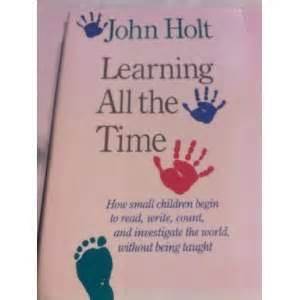
John Holt

"We learn to do something by doing it.  There is no other way."


— John Holt
American Author, Educator
1923 - 1985


Commentary
We take in information about the world outside ourselves through our senses of seeing, hearing, touching, tasting and smelling and it is through these senses that we learn.  When it comes to the classroom, we learn primarily through seeing, hearing and doing.  Usually one or two of these ways of learning will be dominate in a person, but we learn through all three ways and we can improve our ability to learn in a given way.  

How do you learn?  Are you a life-long learner?  Are you a visual learner?  Do you learn best by seeing something?  There are two types of visual learners?  Those that learn through pictures and graphics and those that learn through the written words.  Are you an auditory learner?  Do you learn best by hearing something.  Do you listen to recorded books?  Are you a kinesthetic learner?  Do you learn best by doing?


So how does this apply to the creative leader?  First, how do you best learn your craft of drawing, writing, or acting?  By reading about it?  By watching others?  Or by doing it yourself?  I think that we learn in all three ways, but we learn best by doing.  No matter how much you read, you have to pick up the brush or pen to be successful.  No matter how much time you spend watching others, you have to pick up a pen or brush.  Only in doing can you put what you learned by reading and watching into practice.   If we pay attention to what we do, we can teach ourselves many things.  Reading and watching others, though, will speed up the learning process.


How about how your audience experiences your works of art.  Do they only experience it visually?  Can they hear it?  Can they smell it or taste it?  To me I experience a story or poem differently when I hear than when I read it on a page.  When I listen to a novel while driving, I become part of the world of the novel in a way that does not happen when I read about the world on the page.  I find my others senses are more engaged when I listen to the book.  I see, smell and taste the world in ways that often don't happen when I read.

Creative Practice:
Take a test to determine how you learn best.  Here is one free test that can be found on line. 


Background on Author
John Holt, born in New York City, was the oldest of three children.  He joined the navy and fought in World War II in the Pacific.  After the war, he became a school teacher and taught in Colorado and Boston.  He published his first book, How Children Fail, in 1964.  The controversial book blamed schools for the failure of children.   His follow-up book, How Children Learn, was published in 1967.  I remember in college that I bought bought books from the Doubleday book club.  He wrote 11 books of which two were published after his death.  Holt became disillusioned with the school system and became an early proponent of homeschooling.  His book, Teach Your Own was published in 1981.


Monday, April 29, 2013

Edgar Degas


"A picture is first of all a product of the imagination of the artist; it must never be a copy . . . . The air we see in the painting of the old masters is never the air that we breathe."


Edgar Degas
French Painter
1834 - 1917


Commentary
We all need to encourage, foster and invest in our imagination.  Without imagination, most art, writing and music fail.  Imagination is what we the creators bring to the table.  All creative people have the same raw material.  How we mold and shape that material is what makes each creative person different. 

If we merely copy the work of others, then we are technicians following a pattern.  We need to alter and reshape the landscape of the world we inhabit.  We must imagine new ways of seeing.

Young children are very imaginative.  We all need to become a child again and see the world through a child's eyes.  We need to see the world as if we have never seen it before.  We need to see the world with fresh eyes untainted by experience and knowledge.

Creative Practice
This week I want you to step outside your comfort zone and explore the movement of your body.  Find a large space and where you can move about freely.  Dress in loose-fitting clothes.  Move about the space and explore the following through movement.  (You may want to watch the video below before you start.)
  • Become the color red.
  • Change into a rabbit.
  • Become light blue.
  • Fly like an eagle.
  • Become the color green.
  • Climb like a monkey.
  • Become the tree the monkey is climbing.
  • Become bright pink.
  • Become a runner who has just finished a marathon.
  • Become the bride walking down the aisle to her future husband.
Now, sit down and write for 30 minutes.  After you have finished writing, ask yourself what you learned through this process.  How did the movement influence your writing?


Background of Artist
Edgar Degas was born in Paris, France, the eldest of five children of a modestly wealthy family.  His mother died when he was thirteen.  He began painting at a young age.  His father wanted him to study law, but he did not apply himself to his studies.  He entered art school when he was twenty.  He also spent three years in Italy studying the Italian masters. In 1872 he traveled to New Orleans, Louisiana where his Creole mother was from.  He lived with relatives for a short period of time.

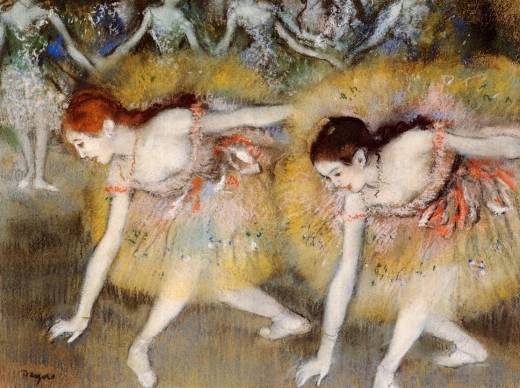
Degas is often identified with the Impressionists, though, he did not identify himself in that way.  He preferred to be called a realist.  His style showed a deep respect for the old masters whom he copied well into middle age.  He began by painting conventional historical paintings such as the Daughter of Jephthah (1859 - 1861) and the Young Spartans (1860 - 62).  In the late 1860's, Degas shifted his subject matter from historical events to contemporary life.  He painted women such as milliners and laundresses at work.  In 1868 he exhibited the first of his paintings of dancers.  More than half his creative output is of dancers.


Video
One of the most powerful classes I have ever taken was a class in in creative drama where we explored the world around us through our bodies.  In order to portray a character, actors have to have immense imagination.  Watch this video of a acting class.


Monday, April 22, 2013

Robert Greene


"At your birth a seed is planted.  That seed is your uniqueness.  It wants to grow, transform itself, and flower to its full potential.  It has a natural, assertive energy to it. Your Life's Task is to bring that seed to flower, to express your uniqueness through your work."


Robert Greene
American Writer/Speaker
1959 -


Commentary
What makes you unique?  What is your life's work?  Are you doing your life's work?  Have you found your passion?  What is the reason you were born?  What are the gifts that you have been given?  What skills do you need to master?

I think my life's work has been to inspire others to be better than they are.  The seed for my life's work found expression when I was young in my desire to be a preacher.  Later, the seed was expressed in my desire to rid the world of racism and war.  Ultimately, my life's work found expression in my speaking and training within health care.  I've touched people's lives through my voice and the telling of motivational stories.

Creative Practice
This week write about your life's work.  What is your purpose for being here?  If you don't know why you are here, then use this writing exercise to help you discover your purpose for being.

Biography
Robert Greene was raised in Los Angeles.  He attended the University of California at Berkeley and the University of Wisconsin at Madison.  Greene estimated that he worked at 80 jobs, including construction, translation, and editing, before becoming a writer.  His first book, The 48 Laws of Power, was published in 2000 and has sold over 1.2 million copies in the United States alone.  His fifth book, Mastery, was published in 2012.  Green speaks five languages and is a student of Zen Buddhism.

A Book Review

Mastery
by Robert Greene

Mastery is a great inspirational book that every creative leader, who wants to master a skill or a talent, should read.  If you want to be a writer, an artist, or a musician, you should read this book.  If you want to own your own company, or be president of a company, or be a successful employee, you should read this book.  If you want to start a new career, become a doctor or a mechanic, or run a marathon, then read this book.

Robert Greene shares the stories of people who have become masters in their fields.  Using the stories of both dead and living masters, Greene reviews what it takes to become a master in a field of endeavor.  He shares the stories of Charles Darwin, Leonardo da Vinci, Albert Einstein, John Coltrane, Martha Graham, Buckminster Fuller, Zora Neale Hurston and Wolfgang Mozart to name a few.  He also shares the stories of living masters like Yoky Matsuoko, Freddie Roach, Daniel Everett and Santiago Calatrava.  From these inspirational stories, Robert Greene identifies the keys to mastery.

This book is a must read for anyone who wants to become a master of some skill or talent.  Pick up a copy today and change your life.

Video

Here is Robert Greene discussing creativity and mastery at Google.


Monday, April 15, 2013

John W. Gardner

"Life is the art of drawing without an eraser."


— John W. Gardner
American Educator, Author
1912 -2002


Commentary
How would you feel if you did not have an eraser?  Or in our current language: a delete key?  How would you feel if whatever you typed into the computer or wrote on paper could not be changed?  Or if your brush strokes could not be covered up?  Or if the song you recorded could be done with only one take?

Some writers and artists suffer from writer's block because they feel their first draft or painting needs to be perfect.  They don't realize that they have an eraser and can change what they write.  We have all been given a great gift in the delete key.  Be sure that you use it responsibly. 

Life unlike art does not have a delete key?  Our actions cannot be erased as much as we would wish they could.  Have you ever done or said something that you wish you could undo?  We all have.  Art gives us this opportunity?  We can rewrite our story — repaint our world.

Creative Practice
This week identify 2 - 3 of your past actions that you wish you could erase.  Then rewrite the story and change your behavior and the outcome.  Or paint a scene from your new story.

Background
John W. Gardner is best known for serving as Secretary of Health, Education and Welfare under President Lyndon B. Johnson.  He also founded Common Cause in 1970.  Between 1955 and 1965, he served as president of the Carnegie Corporation where he helped to shape American education.

Gardner was born in Los Angeles to William and Marie Gardner.  His father died when he was one and he was raised by his mother.  He graduated from Stanford with a masters degree and earned a doctorate degree from the University of California.  In the late 1930's he taught college and then joined the Marines during World War II.

Gardner dropped out of college for a year and a half to try his hand at writing fiction before going back and finishing his degree.  His first of eleven non-fiction books was published in 1961.

Monday, April 8, 2013

Anne Tyler

"If I waited until I felt like writing, I'd never write at all."


— Anne Tyler
American Novelist
1941 -


Commentary
Many beginning writers feel that they can only write when the spirit strikes them.  They wait until they have the urge to write.  Unfortunately, they will write very little because the spirit is often on vacation.  Writers, artists and other creative leaders must develop the discipline and habit of working every day whether they are in the mood or not.  Somedays what they produce will be great and on other days it will be terrible.  The quality does not matter.  Just like there are bad hair days and good hair days, there are bad creative days and good creative days.  They will not always hit a home run or score the winning basket.

So what about you?  Do you wait until the spirit strikes?  Or are you up and at it every day?   Do you have the self-discipline to create something every day?  There is no boss looking over your shoulder or no parent coaxing you out of bed.  You have to be the one to get yourself up writing, painting or dancing.  No one can do it for you.

Creative Practice
Experts say it takes 21 days to form a habit.  So your assignment this week to choose a time every day when you will create.  Then for the next 21 days spend that time creating.  Begin now to form habits of a lifetime.  You are responsible for the life you live.

Background
Anne Tyler, the eldest of four children, was born in Minneapolis, MN.  Her father was a chemist and her mother a social worker.  Her youth was spent in several Quaker communities.  She did not attend public school until she was eleven. She graduated from Duke University and did graduate work in Russian studies.

Tyler has published 19 novels.  The first one, If Morning Ever Comes, was published in 1964.  She won the Pulitzer Prize for her 11th novel Breathing Lessons.

Tyler rarely gives face-to-face interviews.  In her first such interview in thirty-five years with Deirdre Donahue in 2012, she said: "I have to go to my writing room five days a week. I have to put in my time."  Donahue states that Tyler writes in longhand on unlined paper.

Thursday, April 4, 2013

When I'm Sixty-Four

Today, I reach the ripe old age of 64 and must share with you the Beatles song: When I'm 64.  Listen!


To celebrate my birthday, I am giving away a free PDF copy of my book, Mother, Don't Lock Me In That Closet!  Here is a link to download.

https://www.yousendit.com/download/UVJqeEVhU1B6RStFQk1UQw

May your day be full of hope and joy!!!!